

Yes, there's a real difference, and it's a question we hear all the time. The easiest way to get your head around it is with this simple phrase: all bourbon is whiskey, but not all whiskey is bourbon.
Think of "whiskey" as the massive, sprawling family tree for all spirits distilled from grain mash. Bourbon is just one very specific, very American, and legally protected branch on that tree.
The Essential Differences Between Bourbon and Whiskey
Getting a handle on what separates bourbon from the wider world of whiskey is a fantastic starting point for anyone new to the spirit. That "whiskey" family tree includes everything from Scotch and Irish whiskey to Rye and Japanese whisky, each with its own production rules and flavor profiles.
Bourbon is our distinctly American contribution, and it comes with a strict set of rules that give it its signature character. If you want to go deeper into the broader category, you can explore our guide on what makes a whiskey a whiskey.
To quickly see what sets them apart, here's a simple breakdown of the hard-and-fast rules.
| Attribute | Bourbon (A specific type of American Whiskey) | Whiskey (The broader category) |
|---|---|---|
| Origin | Must be made in the United States | Can be made anywhere in the world |
| Primary Grain | At least 51% corn in the mash bill | Varies widely (barley, rye, wheat, corn) |
| Aging Barrel | Must be aged in new, charred oak barrels | Can be aged in new or used barrels |
| Flavor Profile | Generally sweeter with notes of vanilla & caramel | Ranges from smoky, spicy, fruity, to malty |
The Ironclad Rules That Make Bourbon, Bourbon
To really get what separates bourbon from the wider world of whiskey, you have to look at the rulebook. Think of "whiskey" as the broad category for any spirit made from fermented grain. Bourbon, on the other hand, is a specific type of American whiskey that has to follow a very strict set of U.S. federal laws. These aren't just suggestions; they dictate every step of the process and are the reason bourbon tastes the way it does.
This legal framework was locked in on May 4, 1964, when Congress officially declared bourbon a "distinctive product of the United States." It was a huge moment, giving bourbon a protected status that ensures anything with that name on the label is made in America, following a precise formula—a true testament to its heritage. You can find more of these foundational facts over at The B-Line.
The Corn Foundation
First up, the recipe. A bourbon’s grain mix, or mash bill, is legally required to be at least 51% corn. This one rule is the biggest reason for bourbon's signature sweetness. Other grains like rye, wheat, or barley make up the rest, but that corn majority lays down a rich, sweet foundation that immediately sets it apart.
That high-corn content is often why bourbon is so approachable for folks just getting into whiskey. Craft distillers have a lot of fun playing with those other grains to create their own unique spin. A "wheated" bourbon from a maker like Wyoming Whiskey will use wheat to create a softer, gentler profile, while a "high-rye" bourbon from a place like New Riff brings in a bold, peppery spice. You can get a much deeper look into how these grains shape the final spirit in our guide to the bourbon grain bill.
Strict Distillation and Barreling Proofs
The regulations don't stop at the mash. Bourbon has to be distilled to no more than 160 proof (80% ABV). Keeping the proof lower at this stage means more of the original flavors from the grain—the good stuff distillers call congeners—are left in the spirit, making for a richer taste.
Once distilled, the unaged whiskey, or "white dog," must go into the barrel at no more than 125 proof (62.5% ABV). This lower entry proof is critical because it encourages a more balanced, harmonious interaction between the spirit and the oak as it ages.
For new whiskey drinkers, understanding proof is key. A higher proof often means a more intense flavor and alcoholic heat. Starting with a bourbon bottled around 90-100 proof can be a great way to acclimate your palate without overwhelming it.
The New Charred Oak Barrel Requirement
Finally, we get to what might be the most important rule of all: bourbon must be aged in new, charred oak containers. This is absolutely non-negotiable, and it has a massive impact on the final product. The process of charring the inside of the barrel caramelizes the wood sugars, which then leach into the aging whiskey, giving it those classic notes of vanilla, caramel, and toffee.
Because the barrels must be brand new for every batch, bourbon gets 100% of its color and a huge chunk of its flavor directly from that fresh wood. This is why even a younger bourbon can have a deep amber color and a surprisingly complex profile, which is a big difference from other world whiskeys that are often aged in used casks.
How Production Methods Create Different Whiskeys
While legal definitions draw clear lines in the sand, the real story of what makes one whiskey different from another is written during production. The specific choices a distiller makes—from the grain they pick to the barrel they age it in—are what create the incredible spectrum of flavors we find in the bottle.
Getting a handle on these methods is the key to understanding why bourbon tastes so different from its global cousins like Scotch or Irish whiskey.
Grain Bill: The Soul of the Spirit
Every whiskey's journey begins with its grain recipe, known as the mash bill. As we've covered, bourbon's identity is rooted in corn—it must be at least 51% corn, which is where its signature sweetness comes from. Its spicy American cousin, Rye whiskey, has to contain at least 51% rye, giving it those classic peppery and herbal notes you won't find in bourbon.
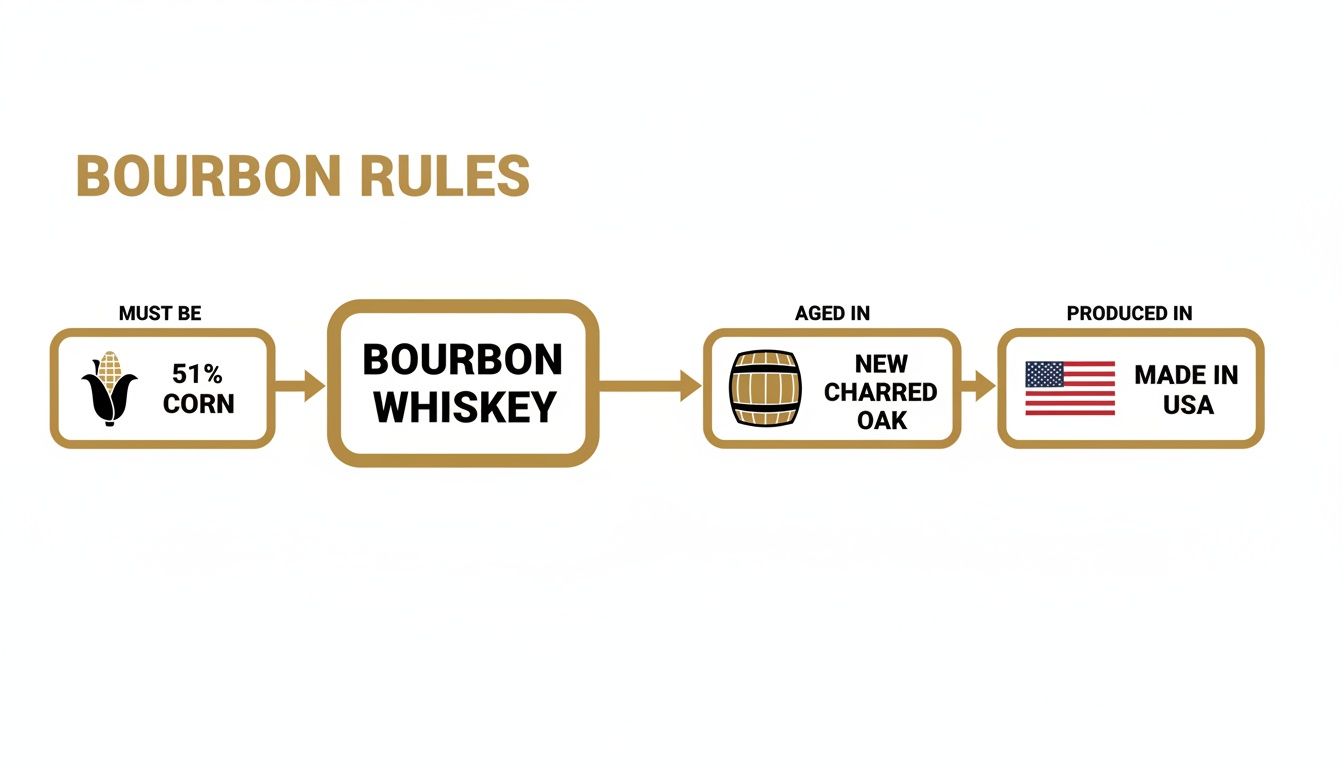
These three pillars—the corn-heavy mash bill, the new charred oak barrel, and its American-made status—are the non-negotiables that make bourbon, well, bourbon.
Distillation: The Art of Purity and Flavor
After the grains ferment into a "distiller's beer," the liquid heads to the still to concentrate the alcohol. The type of still used here has a massive impact on the final spirit. While many bourbons and Scotches use a mix of column and pot stills, the real fork in the road is how many times the spirit is distilled.
Irish whiskey, for example, is famous for being triple-distilled. That extra run through the still strips out more of the heavier oils and compounds, resulting in a much lighter-bodied, smoother, and often fruitier whiskey. It’s one reason newcomers to the category find Irish whiskey so approachable.
Most bourbon and Scotch, however, are distilled just twice. This preserves more of those flavorful, grain-forward compounds, leading to a richer and more robust spirit. To get deeper into the nitty-gritty, check out our article comparing pot stills versus column stills.
Aging: Where the Real Magic Happens
If you want to point to the single biggest factor that separates bourbon from almost every other whiskey, look no further than the barrel. The legal requirement for bourbon to be aged in new, charred oak barrels is an absolute game-changer.
This means every single drop of bourbon is the first liquid to touch that fresh, flame-charred wood, soaking up an intense rush of vanilla, caramel, and baking spice flavors.
For new whiskey drinkers, this is a crucial point: bourbon gets 100% of its color and the majority of its flavor from that brand-new barrel. This is why even a relatively young bourbon can have a deep color and rich taste.
Most other world whiskeys, including Scotch and Irish whiskey, are aged in used barrels. Often, these are the very same barrels that bourbon was just aged in! Distillers also use casks that once held sherry, port, or wine. Because these barrels have already given up their most aggressive wood notes to a previous spirit, they impart a much more subtle, nuanced flavor over a longer period.
It’s the reason a 12-year-old Scotch can be much lighter in color than a 4-year-old bourbon—its cask is on its second or third tour of duty.
To make this all a bit clearer, here’s a quick snapshot of how these production rules stack up against each other.
Bourbon vs Other Whiskeys: A Production Snapshot
| Attribute | Bourbon | Scotch Whisky | Irish Whiskey | Rye Whiskey |
|---|---|---|---|---|
| Primary Grain | At least 51% corn | Malted Barley (single malts) | Malted & Unmalted Barley | At least 51% rye |
| Barrel Type | New, Charred Oak | Used (ex-bourbon, sherry) | Used (ex-bourbon, wine) | New, Charred Oak |
| Distillation | Typically Twice | Typically Twice | Typically Triple | Typically Twice |
| Flavor Driver | Sweetness from corn & oak | Malty, often smoky/peaty | Smooth, fruity, light | Spicy, peppery, bold |
As you can see, what happens in the distillery and the rickhouse is what truly defines the spirit in your glass. These aren't just arbitrary rules; they are the very blueprints for flavor.
Diving Into Bourbon vs. Whiskey Flavors
Those rules and production methods we just walked through? They aren't just a bunch of technical jargon. They're the literal recipe for what you taste in the glass, the very blueprint that separates bourbon from the vast, wild world of whiskey.
Getting a handle on this connection is what turns a simple sip into a real exploration of craft, place, and process.
Thanks to that corn-heavy mash bill and its time spent in brand-new, charred oak barrels, bourbon almost always leans into a sweet, rich profile. You’ll immediately pick up on big notes of caramel, vanilla, and toffee. Layered underneath, you'll often find hints of baking spices like cinnamon and nutmeg, all held together by a pleasant oaky backbone from that fresh barrel. For a lot of newcomers, that approachable sweetness is exactly what makes bourbon such a great gateway into American whiskey.
Exploring the Wider Whiskey Spectrum
But once you step outside the bourbon sandbox, the flavor landscape just explodes. Every style of whiskey tells the story of how and where it was made.
- American Rye Whiskey: Think of rye as bourbon’s spicy cousin. It hits you with a bold, peppery kick, often with notes of mint, dill, and dried herbs. It’s generally drier and more assertive, which is why it’s a bartender's favorite for classic cocktails that need a little backbone.
- Scotch Whisky: This category is a world unto itself. You could get an Islay Scotch that smacks you with intense smoke, briny seaweed, and an almost medicinal quality. Or, you could pour a Speyside single malt that’s light, grassy, and full of bright, honeyed apple notes. The range is just massive.
- Irish Whiskey: Known for its exceptionally smooth and light character, Irish whiskey is often triple-distilled and aged in used barrels. This gives it a softer touch, with common flavors like green apple, honey, and delicate floral notes.
This is where the creativity of American craft whiskey really gets to shine. Distilleries like Frey Ranch in Nevada are doing amazing things with their "farm-to-glass" whiskeys. They produce both a classic bourbon and a bold 100% rye, giving you the perfect opportunity to taste the impact of the grain side-by-side.
If you're new to whiskey, one of the best ways to learn is by tasting a bourbon and a rye from the same distillery. It’s a fantastic way to isolate the main grain difference so you can clearly pinpoint bourbon’s signature sweetness versus rye’s distinct spice.
It’s Not Just About the Grain
While the mash bill sets the stage, it's far from the whole story. Things like the distillery’s unique yeast strain, the local climate where the barrels are aging, and the final bottling proof can sometimes create even more flavor differences than the grain itself.
Interestingly, that flavor gap between bourbon and rye might be smaller than you’d think. A groundbreaking 2016 study revealed that even seasoned whiskey lovers had a tough time reliably telling them apart in blind tastings. They often ended up grouping the spirits by brand or proof instead of by grain. You can learn more about these sensory findings and how our brains actually process these complex flavors.
It all points to an essential truth for any drinker: at the end of the day, your own palate is the only judge that matters.
How to Start Your First Whiskey Tasting
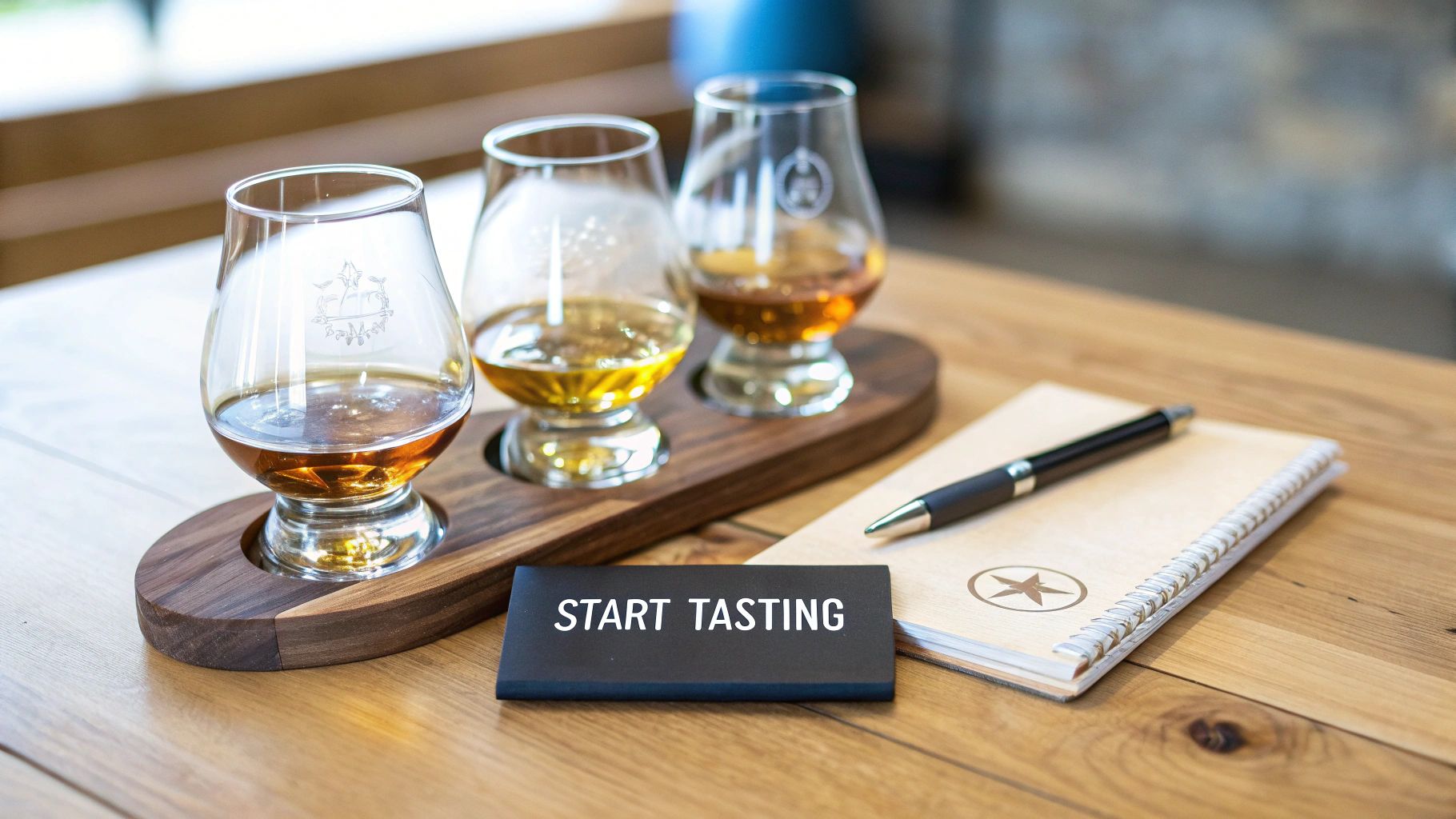
All the theory and legal jargon in the world can't replace one simple truth: the best way to really get the difference between bourbon and whiskey is to taste them for yourself. A proper tasting lets you stop reading about flavor notes and actually start finding them on your own.
Don't get hung up on being "right." The only goal here is to pay attention and figure out what you like. Tasting is a simple four-step process that pulls in all your senses, unlocking the story inside the glass and helping you appreciate the craft behind every drop.
A Simple Guide for New Whiskey Drinkers
Before you dive in, just remember that your palate is your own. Trust what you smell and taste—there are no wrong answers in this game.
- Look: First, hold your glass up to a light source. Check out the color. Is it a pale straw, a rich gold, or a deep, dark amber? A bourbon aged in new charred oak is almost always going to have a darker, more intense color than a Scotch of the same age that was matured in a used barrel.
- Smell (Nose): Give the whiskey a gentle swirl in the glass and bring it up to your nose. It helps to keep your mouth slightly open while you take a light sniff. What are you picking up? Is it sweet vanilla, spicy cinnamon, crisp apple, or something else entirely?
- Sip: Now, take a small sip. Let it roll over your entire tongue before you swallow. This is the moment you'll answer the is there a difference between bourbon and whiskey question for yourself. What flavors jump out? Is it sweet like caramel, spicy like cracked black pepper, or fruity like dark cherries?
- Finish: After you swallow, pay attention to what's left behind. That lingering sensation is the "finish." Is it long and warming, or does it disappear quickly, leaving things short and crisp?
Tasting Tip for Beginners: Don't hesitate to add a drop or two of water to your whiskey, especially if it’s a high-proof pour. This little trick can really open up the aromas and dial back the alcoholic heat, making it much easier to pick out individual flavors.
Your First Tasting Flight
The fastest way to learn is by comparing different styles side-by-side. A tasting flight makes all those subtle distinctions feel real and tangible.
To get started, try pouring small amounts of three different American whiskeys. This will show you just how much a single grain can change the entire experience.
- A Classic Bourbon: Kick things off with a traditional, corn-forward bourbon. You're looking for those classic sweet notes of vanilla, caramel, and a touch of oak.
- A High-Rye Bourbon or Rye Whiskey: Next up, grab something with a lot of rye in the mash bill. This lets you directly compare the sweetness of bourbon with rye's signature peppery spice and herbal kick.
- A Wheated Bourbon: Finally, pour a "wheater." Using wheat as the secondary grain creates a much softer, gentler profile, often bringing out flavors of honey, baked bread, and toffee.
There are so many incredible American craft distilleries that offer a perfect way to explore these profiles. Brands like Balcones in Texas or High West in Utah are crafting a huge range of whiskeys, giving you a chance to taste how grain, climate, and technique create something unique in every sip. By tasting actively, you start building confidence and learning to trust your own palate.
Why Blind Tasting Is the Best Way to Learn Your Palate
Alright, so you’ve learned the rules, compared the production methods, and explored the typical flavor profiles. Now it’s time for the final—and most important—step: trusting your own senses. The single best way to discover what you genuinely enjoy is through a blind tasting, a method that strips away everything but the spirit in your glass.
Without a fancy label, a high price tag, or a famous brand name influencing your judgment, you're forced to rely on nothing but aroma and taste. This is where the magic happens. You might just discover your palate leans toward the peppery spice of a high-rye bourbon from an unknown craft distillery, or maybe it favors the soft, mellow notes of a wheated whiskey you’ve never even heard of.
Blind tasting removes bias. It’s not about guessing what’s in the glass; it’s about discovering what you genuinely like without the power of marketing swaying your opinion.
Discover Your True Preferences
This is where the real fun begins. A blind tasting setup allows you to focus purely on the whiskey’s character and quality, which is an incredible tool for building confidence and developing your palate, especially if you're new to the game.
It’s the perfect way to finally answer the "is there a difference between bourbon and whiskey" question for yourself.
- Remove Preconceptions: You might be surprised to find you prefer a lesser-known American craft whiskey over a famous, top-shelf brand. It happens all the time.
- Focus on Flavor: It forces you to identify specific notes—caramel, spice, fruit, oak—without a label telling you what you should be tasting.
- Build Confidence: Each tasting helps you become more attuned to the nuances that make every single spirit unique.
At Blind Barrels, we built our entire experience around this powerful concept. Our quarterly kits feature four unique samples from top-tier American craft distilleries, all presented completely blind. It’s your opportunity to move beyond reading and start a true tasting adventure—one that will show you what you really love to drink.
Bourbon vs. Whiskey: Your Questions Answered
Even after laying out all the rules, a few common questions always seem to pop up. Let's tackle some of the most persistent myths and clear up the confusion once and for all.
Does Bourbon Have to Be Made in Kentucky?
This is easily one of the biggest myths in the American whiskey world, and the answer is a firm no.
While it’s true that Kentucky is the heartland of bourbon production—cranking out about 95% of the world's supply—the only geographical requirement in the rulebook is that it must be made in the United States. Period.
Today, you can find absolutely stellar bourbons coming from craft distilleries all across the country. Places like Texas, New York, and Colorado are making names for themselves, producing unique whiskeys that are a direct reflection of their local grains and climates.
Here's a pro tip for anyone starting their whiskey journey: try bourbons from different states. Pit a Texas bourbon, which ages like crazy in the intense heat, against a classic Kentucky bourbon of the same age. You'll be amazed at the differences in oak, sweetness, and overall complexity.
Is Bourbon Sweeter Than Other Whiskeys?
You’re not imagining it—bourbon generally is sweeter than most other whiskeys, and it all comes down to two of its core legal requirements.
First, the recipe has to be at least 51% corn, which is a much sweeter grain than rye or barley. Second, it has to be aged in brand-new, charred oak barrels. That process is what pulls out all those delicious vanilla, caramel, and toffee notes from the wood.
When you put those two rules together, you get a spirit that’s naturally fuller-bodied and sweeter than, say, a spicy, peppery rye or a smoky, malty Scotch.
What's the Difference Between Whisky and Whiskey?
Ah, the great spelling debate. That little "e" (or lack thereof) is actually a handy clue that tells you where the spirit likely comes from.
- Whiskey (with an 'e') is the spelling you'll see in the United States and Ireland.
- Whisky (no 'e') is the standard for spirits made in Scotland, Canada, and Japan.
It’s not a hard-and-fast law, but it’s a pretty reliable rule of thumb. Knowing this simple difference can make navigating the global whiskey aisle feel a lot less intimidating.
Ready to figure out what you truly like, without being swayed by a fancy label? The Blind Barrels tasting experience is designed to help you explore incredible American craft whiskeys and let your palate be the judge. Find your next favorite bottle and discover what's out there.