

You're holding a glass of whiskey while someone nearby names dried cherries, baking spice and toasted oak. You smell whiskey, mostly, and wonder whether they're noticing something you can't or just guessing with more confidence.
A useful class helps you answer that question without embarrassment. You practice specific tasks, write down your impressions before anyone influences them, and check whether your answers become more accurate over time.
What a Palate Training Class Actually Teaches
A palate training class is structured practice in naming and comparing what you smell and taste, using shared vocabulary, reference samples and feedback rather than a casual pour with friends.
A bar tasting is like taking a walk. A class is more like training with a coach and a stopwatch: you have a task, a repeatable method and a way to check your progress. Enjoyment still matters, but entertainment isn't the only outcome.
Where the method comes from
Modern classes inherit the blind, coded and numbered methods that food researchers standardized during the twentieth century, as described in the Journal of the Institute of Brewing article on whiskey sensory training. Those methods help instructors compare observations without letting a familiar label supply the answer.
You don't need laboratory ambitions to benefit. You need a format that gives you enough guidance to practice correctly.
Palate training class formats compared
| Format | Typical length | What you get | Best for |
|---|---|---|---|
| Live in-person workshop | A single scheduled tasting session | Guided pours, shared aroma wheel, instructor feedback | First-timers who want a social start |
| Multi-week live course | 4 to 8 weekly sessions | Repeated exposure, homework, progress checks | Learners who want measurable improvement |
| Self-paced online course | Often 4 to 10 hours of video and quizzes | Vocabulary lessons, aroma primers, flexible timing | Budget-minded or busy learners |
| Blind tasting subscription kit | Quarterly, 4 samples per kit | Hidden labels, tasting table, QR reveal, guessing game | Ongoing practice at home |
| University or professional sensory course | Multi-week with formal assessment | Threshold testing, discrimination tests, statistics | Professionals and researchers |
Treat these as format descriptions, not promises about every provider's schedule. Check the actual syllabus before paying.
The skills behind the tasting notes
Most palate training classes cover aroma recognition, flavor, finish, mouthfeel and matching sensations to words. Mouthfeel means physical sensations such as oiliness, dryness or heat; finish means what remains after you swallow or spit.
Everyday drinks offer useful practice material too. For coffee drinkers, PureHQ's guide to coffee bean quality from PureHQ Inc. provides context for paying closer attention to a familiar ingredient.
The right format fits your goal, budget and available time. A professional qualification and a relaxed introduction to American craft whiskey solve different problems.
Why Training Your Palate Actually Works
Before you learn musical notes, a chord can sound like one blended noise. Once you can recognize its parts, you have a better way to describe what you hear and compare it with another chord.
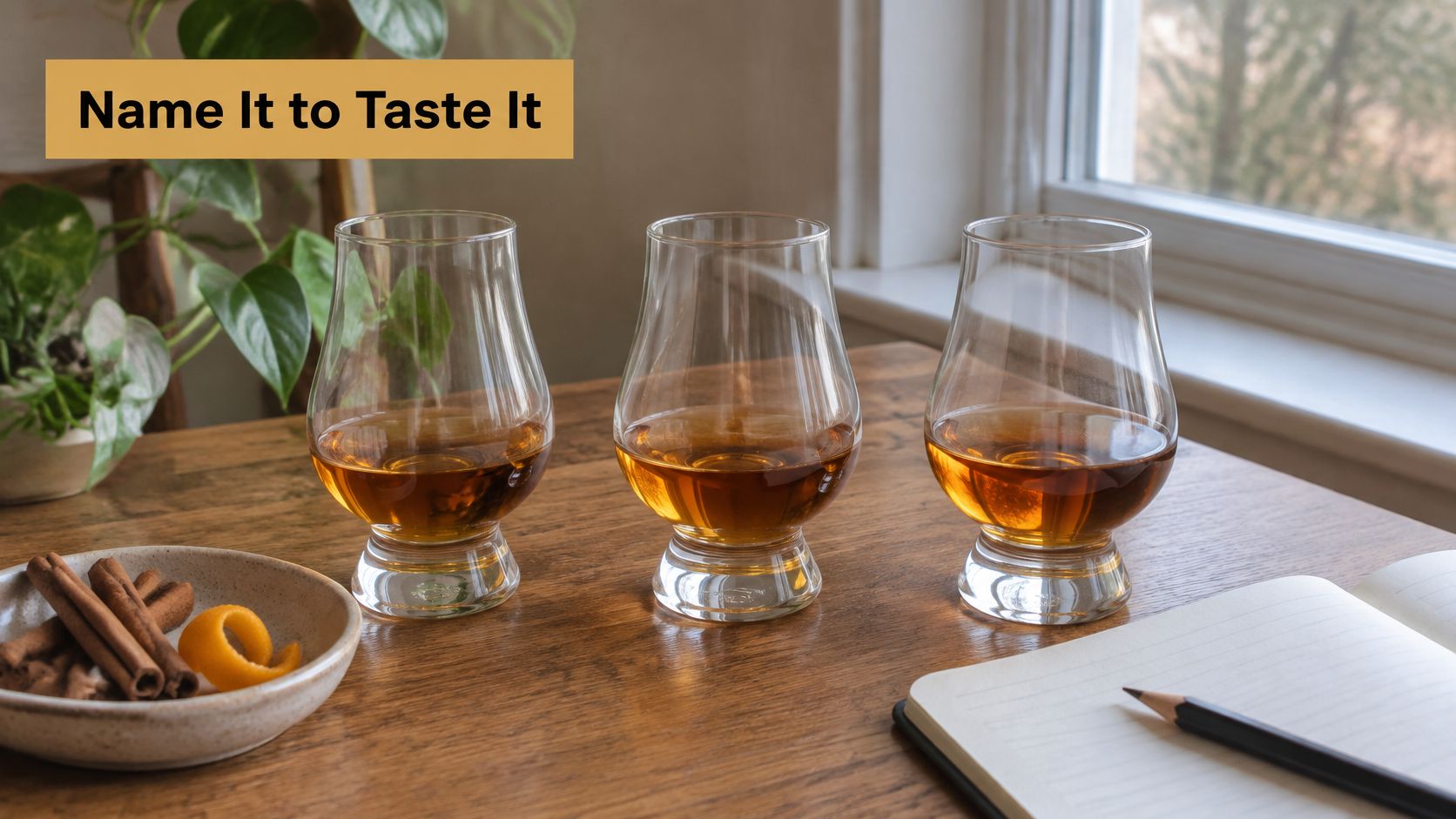
Smell works similarly as a learning exercise. Giving a familiar sensation a name makes it easier to organize, discuss and look for again, although memorizing a word doesn't guarantee accurate recognition.
What structured learning can change
A 2016 study published in Beverages evaluated 133 consumers before and after a 12-week university wine course combining education with sensory training; liking increased significantly for several white and rosé wines, while responses to Pinot Noir and Cabernet-Merlot remained unchanged, and confidence was measured using a 5-point scale.
That's useful evidence, but it isn't a promise that instruction makes everyone like every drink. The outcome concerned particular wines and particular responses, not universal tasting expertise.
For whiskey beginners, the practical case for training is more straightforward: a method gives you something useful to do besides searching for impressive adjectives.
- Usable vocabulary: You can explain whether a pour seems grainy, fruity, woody or spicy.
- More deliberate judgments: You learn to commit an observation to paper before hearing someone else's answer.
- Clearer preferences: You can distinguish liking a whiskey from recognizing its characteristics.
- Sharper bottle comparisons: You compare the same features rather than relying on a general impression.
- Less group pressure: A familiar tasting routine gives you a starting point when others sound more experienced.
Turn attention into a repeatable task
A beginner comparing Wigle Whiskey with Jeptha Creed doesn't need to identify the distillery immediately. Describing how the pours differ in aroma, texture and finish is already a useful task.
A sensory evaluation method gives those observations a consistent order, so you're not judging aroma carefully in one glass and ignoring it in another.
Progress means making a clearer, better-supported judgment, not producing a longer tasting note.
The wine findings support a modest conclusion: education can change responses, but gains can be specific to the styles and tasks practiced.
The Three Controls Every Good Class Uses
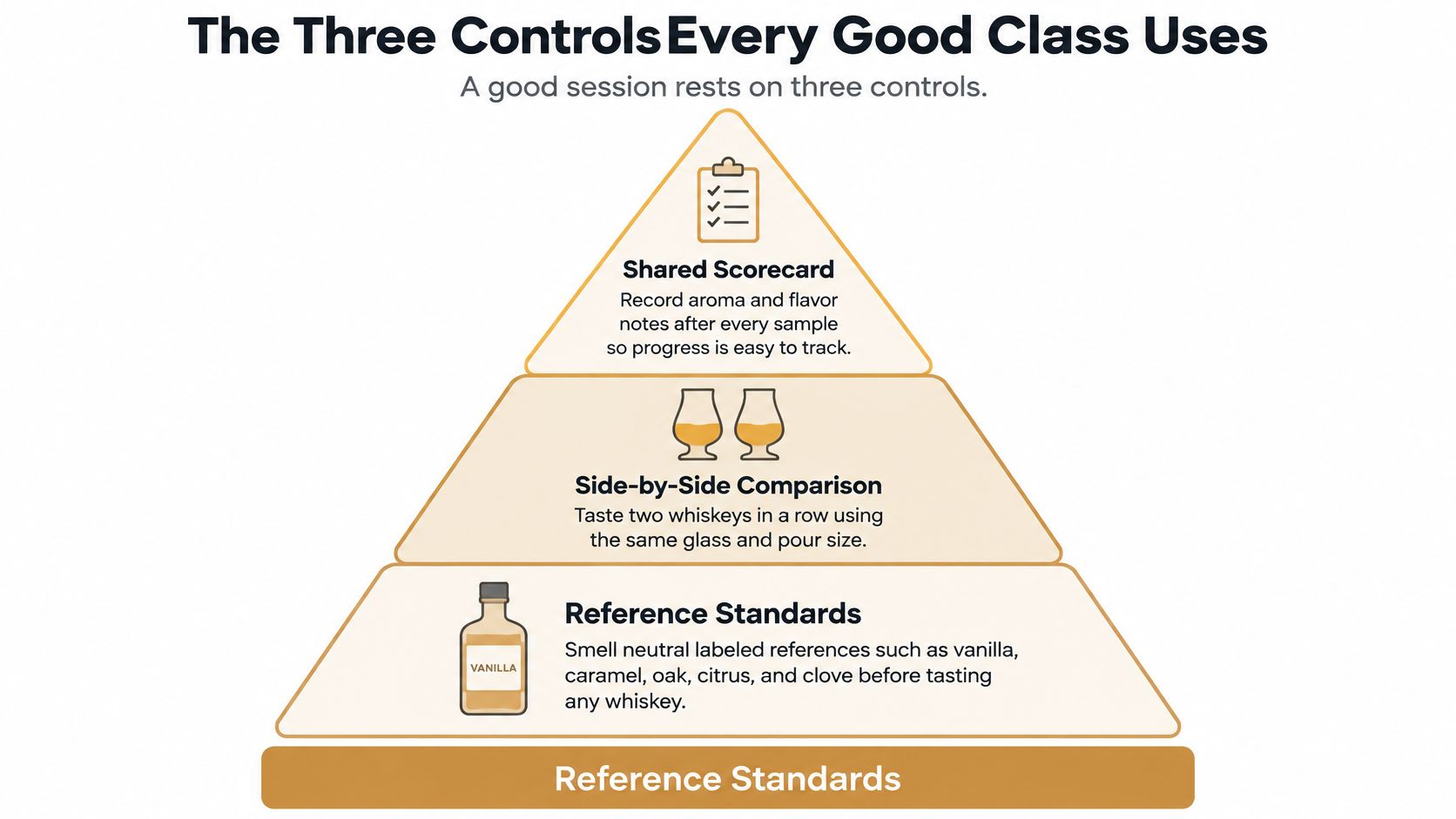
A good session rests on reference standards, consistent serving and blind comparison. Without them, a higher score might reflect an easier sample, a helpful hint or a different room rather than better sensory skill.
Give every descriptor an anchor
Reference standards are labeled examples learners smell before evaluating whiskey. Vanilla, caramel, oak, citrus and clove give the group something concrete to discuss.
Use safe, food-grade materials, and smell rather than ingest unfamiliar reference preparations. The instructor should explain what each reference illustrates instead of treating an aroma wheel as an answer sheet.
Keep the comparison fair
Consistent serving means matching glassware, pour volume, temperature and room conditions. Don't compare a cold sample in a tumbler with a warmer sample in a narrow tasting glass and assume every difference comes from the whiskey.
For blind comparison, the instructor codes the samples, changes their order and asks everyone to record an independent first impression. Discussion comes afterward.
The USDA-supported project on multisensory food perception identifies influences including visual cues, lighting, background sound, serving temperature and texture, and reports odor-identification scores rising from 4.25 to 5.31 out of 10 following short intensive sensory training.
That supports making room for brief, repeatable exercises. It doesn't establish that a long masterclass is ineffective or that shorter instruction always wins.
Personal conditions matter too. Fatigue, recently eaten food, cooking smells, candles, background noise, medications, respiratory conditions and alcohol tolerance can complicate a session; note them rather than treating every poor result as lost ability.
- Ask about pours: Are volume, glassware and temperature matched?
- Ask about the room: Can participants use scent-only or alcohol-free references?
- Ask about order: Are samples coded, with private notes taken before discussion?
Keep score sheets private in mixed-experience groups. A descriptor is a starting point for discussion, not a verdict on someone's taste or status.
How to Choose the Right Class
Start with the word craft, because instructors sometimes use it without explaining what they mean. A small-looking bottle or unfamiliar label isn't a production definition.
The Blind Barrels guide to American craft distilleries explains that the American Craft Spirits Association's definition includes a licensed, independently controlled U.S. producer that markets itself as craft, follows its ethical standards and removes no more than 750,000 proof gallons from bond annually, approximately 394,317 nine-liter cases, while the American Distilling Institute uses a narrower ceiling of 100,000 proof gallons, roughly 52,575 nine-liter cases.
Ask which definition an instructor follows. These are industry definitions, not proof that a whiskey will taste better.
Compare the teaching, not the adjectives
Criteria for judging a palate training class
| Criterion | What to look for | Red flag |
|---|---|---|
| Blind or coded samples | Brand, price and age statements hidden | Bottles named before the first pour |
| Whiskey-specific focus | Bourbon, rye and single malt compared side by side | Only a generic wine-style flavor wheel |
| Scoring and feedback | Accuracy scores for age, proof, style and aroma family | Everyone gets praise and no measured result |
| Producer transparency | Named craft distilleries with grain, milling and still details | Vague premium language with no production facts |
| Group size and privacy | Small groups and private score sheets | Scores read aloud to the whole room |
| Context control | Consistent pours, steady room conditions and an alcohol-free aroma option | Food, loud music or uneven pour sizes |
| Repeat practice | Multi-session course or quarterly kit | One evening with no follow-up |
Read the scoring row carefully. Age and proof guesses can be entertaining, but an instructor should keep those results separate from aroma recognition and explain what counts as correct.
Producer transparency should also mean more than a founder's story. USA Today's craft whiskey profiles describe Pittsburgh's Wigle Whiskey using regional organic corn, wheat and malted barley, milling on-site and pot-distilling its products, while Kentucky's Jeptha Creed operates on a 64-acre farm and uses Bloody Butcher corn with malted rye, wheat and barley in its Straight Four Grain Bourbon.
Those details supply questions to investigate, not flavors you must find. Don't let knowing the grain recipe pressure you into reporting sweetness or spice.
Separate instruction from practice materials
A quarterly blind kit such as Blind Barrels provides four samples from small American craft distilleries, a tasting table, a QR reveal, a game scoring age, proof and type guesses, and access to discounted full bottles. That suits ongoing home practice more than live instruction.
Selection rule: Rule out a skill-building class that lacks blind samples or meaningful scoring before comparing décor, bottle prestige or promotional language.
Blind Tasting Drills and a Four-Week Starter Plan
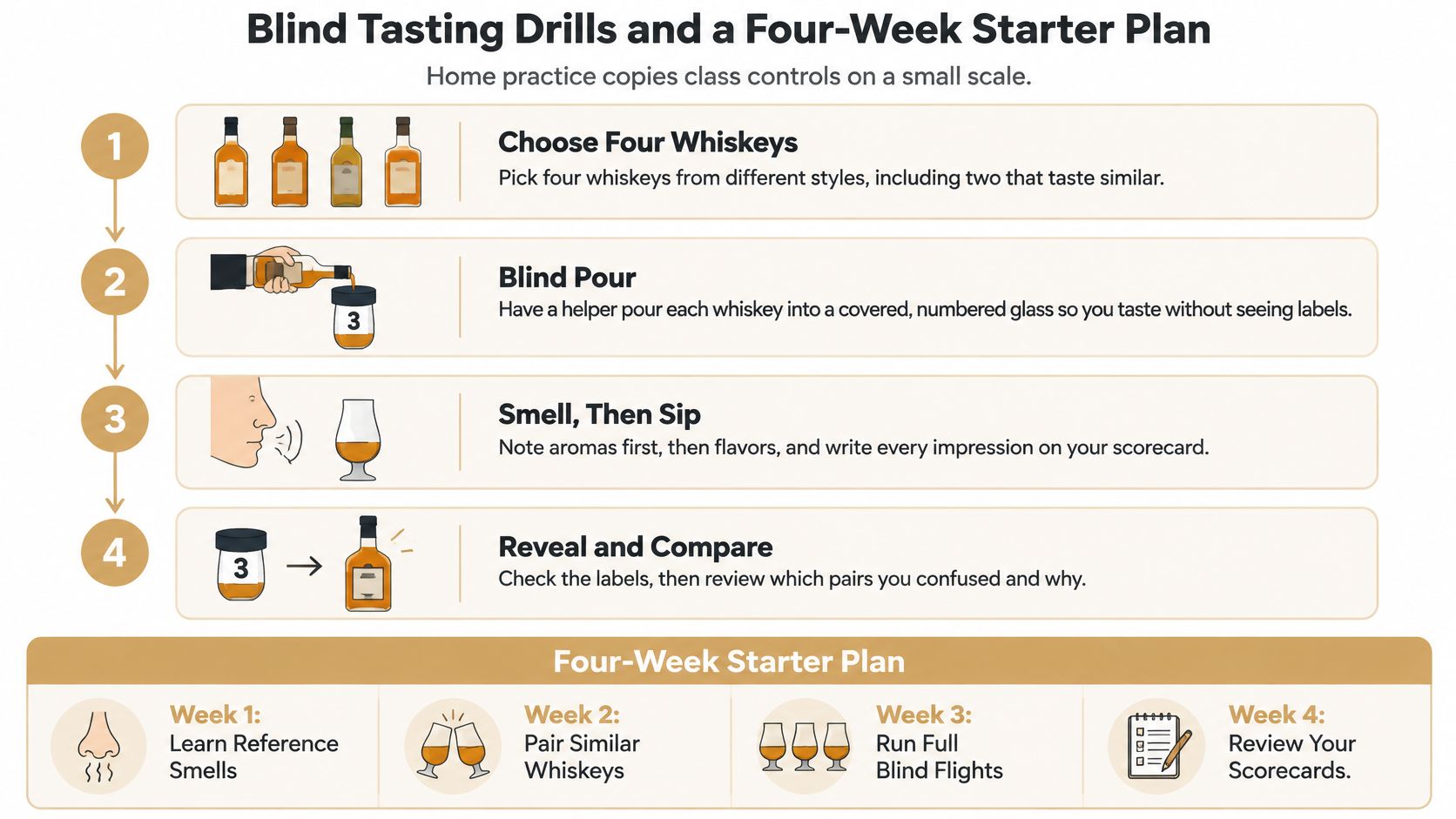
Home practice works when you make the task small and repeatable. Use a helper, matching glasses, removable labels, a measuring dropper and a notebook.
The DLG guide to odor and aroma panel training distinguishes detection, noticing an odor, from recognition, identifying it. Record those separately: sensing something unfamiliar isn't the same as failing to smell it.
Run a controlled flight
- Choose four whiskeys. Include different styles and two that taste similar. American craft bottles such as Wigle and Jeptha Creed can join the comparison.
- Hide the labels. Have a helper pour coded glasses and keep the bottles out of sight.
- Try a triangle test. Use three glasses, two identical, and select the odd sample. Record confidence from 1 to 5 before the reveal; avoid repeated passes that turn the exercise into searching for confirmation.
- Compare dilution. Taste a sample neat, then add measured water, starting with a few drops; The Daily Pour's whiskey drinking guide also discusses approximately 20% water as an aroma-opening approach. Record heat, sweetness, aroma and finish.
- Sort aroma families. Use fruit, grain, oak, spice, floral or fermentation.
- Make product guesses. Write age, proof and style separately from sensory descriptions.
- Reveal and log. Record correct identifications, aroma-family matches and confidence using a whiskey tasting notes template.
Use neutral-tasting water consistently. Water Filter Advisor's explanation of how water quality affects coffee offers useful context for noticing the water you add to another drink.
Keep the starter plan manageable
Keep practice near 20 minutes, using small pours and spitting when appropriate. These are suggested exercise settings, not validated training doses.
| Practice week | Main task |
|---|---|
| Week one | Run the triangle test and reveal using two bottles |
| Week two | Sort four pours into aroma families |
| Week three | Guess age, proof and style before revealing labels |
| Week four | Compare neat and diluted samples |
Don't drive after drinking. Scent-only practice remains useful when drinking isn't appropriate.
Limits and Common Palate Myths
A 2025 review available through PubMed Central reports that odor labeling and attribute lists can improve identification of trained aromas without necessarily transferring to unfamiliar odors, and describes a five-week blind-wine-tasting study that found better discrimination than a control group.
Neither finding establishes that a learner can reliably identify an arbitrary whiskey's age, proof or mash bill. Improvement on a practiced task is worthwhile without being a universal tasting credential.
Replace the myth with a better test
- You need a natural gift. Practice can produce measurable change on specific tasks. Start with familiar reference smells rather than judging yourself against an instructor's vocabulary.
- An expensive class must be better. Price doesn't tell you whether feedback is useful. Ask to see a sample scorecard and an explanation of how the instructor handles wrong answers.
- Recognizing vanilla means you can name a bourbon. A descriptor isn't a product identification. Keep the aroma observation even when the bottle guess is wrong.
- A high score proves expertise. A four-sample kit is a small test. Try unfamiliar samples before treating a strong result as evidence of broad ability.
Measure accuracy without grading enjoyment
A class score measures performance on its stated identification task. It doesn't establish which whiskey is best, and it shouldn't overrule your preference.
You might correctly recognize an oak-heavy whiskey and still dislike it. You might also enjoy a pour while missing its category entirely; neither result requires an apology.
Confidence is useful information only when you compare it with correctness.
There's no established fixed number of repetitions that guarantees expertise. As a practical review window, track eight to twelve sessions, then examine your accuracy trend rather than celebrating one perfect flight.
Look especially at confident mistakes. If your certainty rises while your correct answers don't, change the practice task or ask for better feedback rather than adding more elaborate tasting language.
Pick Your Format and Take the First Step
Choose the format that gives you the kind of help you need. For measurable skill, reject options without blind samples or scoring before comparing schedules and prices.
- A social introduction: Choose a live in-person workshop where you can ask beginner questions.
- Measurable development: Choose a multi-week live course with homework and individual feedback.
- Ongoing home practice: Choose a quarterly blind kit and use a consistent drill alongside it.
- Professional or research work: Choose a formal sensory course with assessment and instruction in interpreting results.
Make the first booking purposeful
If you're new to whiskey, look for bourbon, rye and single malt rather than a flight of nearly identical bottles. Try each neat before deciding whether to add water, but don't force yourself through uncomfortable alcohol heat.
For home delivery, compare what's included using a whiskey subscription buying guide. Check whether you're buying instruction, practice materials or primarily a discovery experience.
A couples' evening or group event can include a separate alcohol-free social element. For a larger gathering, The Matcha Bike's option to bring a mint-green matcha bike at your event could serve that role; keep flavored drinks and service activity outside the controlled tasting period.
Book a workshop or course that passes your checks, or order a blind kit and schedule the first exercise when it arrives. Set aside a notebook page each week for the task, your answer, your confidence and the reveal.
The useful first step isn't buying a more prestigious bottle. It's choosing a practice you can repeat and evaluate with a clear, unbiased ear.
Blind Barrels offers quarterly blind whiskey tasting kits featuring small American craft distilleries, with tasting tables, label reveals and a guessing game. Visit Blind Barrels to explore a home-practice option, then use each reveal to compare what you noticed with what you guessed.