

You've poured a beautiful Scotch, set out the ice, and reached for the nearest glass. It might be a heavy tumbler, a narrow tasting glass, or a mismatched piece from the cupboard. The whisky hasn't changed, but the first impression can. One glass may send fruit and oak toward your nose, while another lets the aromas spread so widely that the pour feels quieter.
That's why Scotch glass sets deserve more attention than their gift-box appearance suggests. They're not all designed for the same job. A tapered glass supports careful nosing and neat pours, while a broad tumbler handles ice, cocktails, and relaxed everyday drinking with greater ease.

Introduction to Scotch Glass Sets and Why They Matter
A useful way to think about glassware is to compare it with listening to music. The whisky is the recording, but the glass changes how the sound reaches you. A narrow bowl gathers the aromatic “notes” before they disappear, while a wide tumbler gives the spirit more room to open into the surrounding air.
For a new whisky drinker, that difference can be surprisingly helpful. If you're trying to identify apple, pear, raisin, smoke, or oak, a glass that directs aroma toward your nose gives you a clearer starting point. You don't need an experienced palate to benefit. You only need to pause, swirl gently, and smell before tasting.
A set also solves a practical problem. One glass can make a tasting feel intentional, but a matching group makes it easier to compare pours, welcome friends, or give a thoughtful present. The right set supports the way you drink rather than forcing every whisky into one shape.
What a set promises
Most buyers are choosing among three experiences:
- Focused tasting: A tapered Glencairn-style or tulip glass emphasizes aroma and neat whisky.
- Flexible enjoyment: A rocks tumbler accommodates ice, water, and whisky cocktails.
- Gift presentation: Matching glasses, a substantial base, and attractive packaging create a ready-to-open experience.
None of these uses makes another style wrong. A tumbler isn't a failed tasting glass, and a specialist nosing glass isn't automatically the right choice for an Old Fashioned.
The best purchase starts with a simple question: Who will use the set, and how will they pour the whisky? From there, shape, material, capacity, and durability become easier to judge.
How Scotch Glass Sets Evolved From Quaich to Modern Tasting Glass
Scotch drinking vessels began with a very different purpose from today's tasting sets. The Scottish quaich first appeared in the 16th century as a shallow wooden cup with small side handles, a form associated with shared drinking and practical hospitality. Its shape encouraged people to hold the vessel securely and pass it around, rather than study a whisky's aroma one careful nosing session at a time. Scotch Whisky Magazine's history of drinking vessels traces this early lineage.
By the 19th century, tumblers had become more common and the quaich's dominance had ended. Commercialized glass production lowered glass prices and increased the circulation of drinking glasses, making the tumbler a more accessible everyday choice. The broad, stable form also suited casual service, ice, and social drinking.
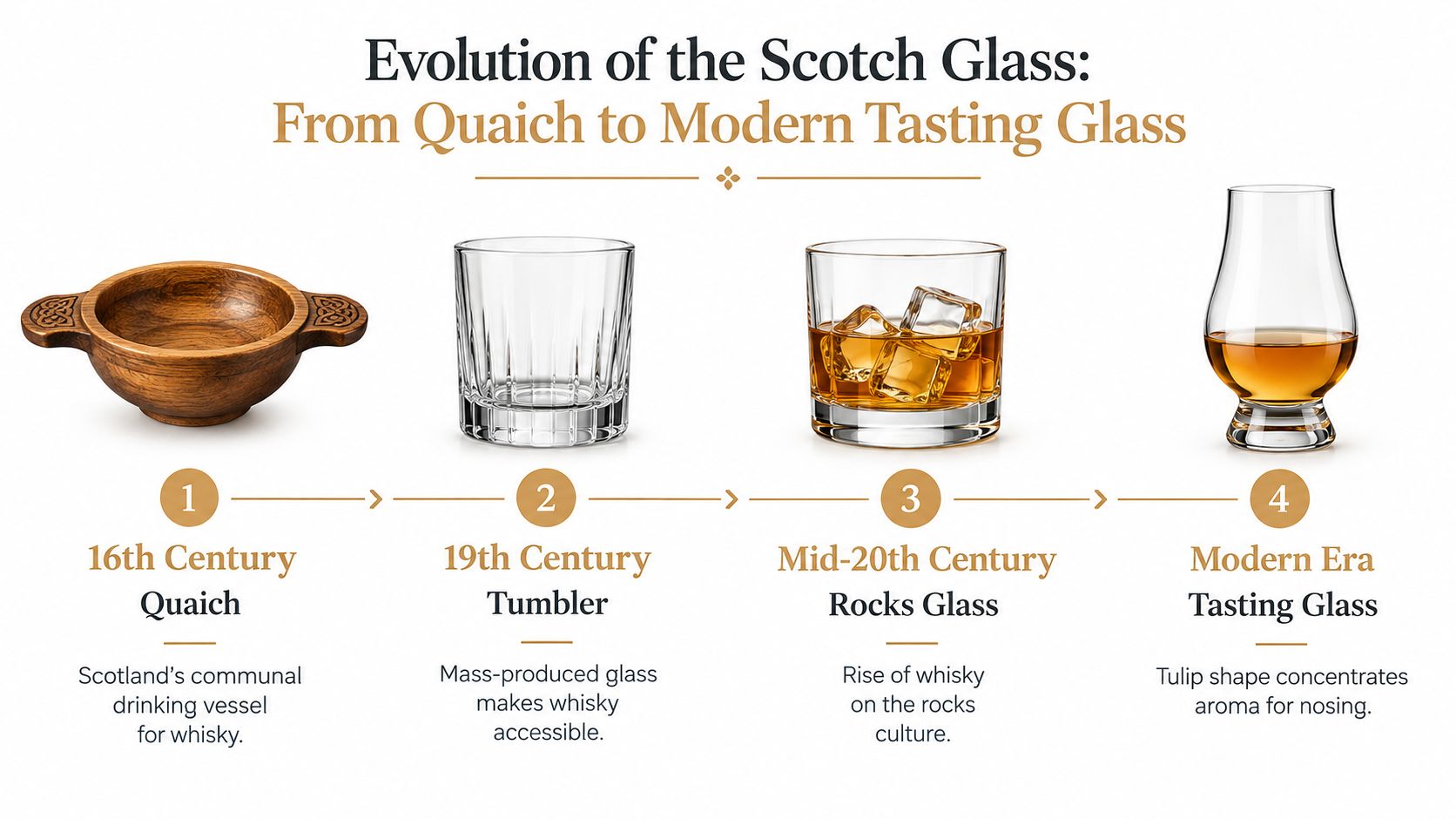
From shared vessel to sensory tool
The modern tasting glass represents a change in priorities. Instead of holding the drink, it helps manage the space above the liquid, known as the headspace. A tapered bowl narrows that space toward the rim, encouraging aromatic compounds to collect where the drinker smells them.
The Glencairn whisky glass marked a modern milestone when it was introduced in 2001 as a purpose-built glass for whisky. The Scotch Whisky Association formally endorsed it in 2005, the first time a dedicated whisky glass received official recognition from the Scotch sector, according to the same historical account.
That progression explains why contemporary sets often combine heritage, standardization, and presentation. The quaich represents shared utility. The tumbler represents accessible glassware and relaxed service. The Glencairn represents a more deliberate interest in aroma capture and tasting precision.
A global premium category
Scotch glass sets now belong to a worldwide premium spirits accessory category. Market coverage identifies North America, Europe, and Asia-Pacific as key regions, with the United States, Canada, the United Kingdom, Germany, France, China, Japan, South Korea, and India among the major markets listed in the category. Verified Market Reports' whiskey-glass market overview also identifies North America and Europe as dominant regions, while describing Asia-Pacific as the fastest-growing area because of rising disposable incomes and interest in premium spirits.
That global reach helps explain the variety on store shelves. Brands such as Glencairn Crystal, Riedel, Villeroy & Boch, Spiegelau, Waterford Crystal, and Luigi Bormioli connect whisky service with luxury tableware. A modern set is therefore more than a Scottish novelty. It's the retail expression of a long design journey from communal cup to specialized sensory instrument.
How Glass Shape and Size Shape Aroma and Flavor
Glass shape matters because whisky is experienced through the nose before it reaches the palate. Think of a tapered glass as a funnel. It doesn't create new aromas, but it helps direct existing volatile compounds toward you instead of allowing them to disperse across a wide opening.
An ISO 3591-style tasting glass uses a tulip profile, with a bowl wider than its rim. Commonly cited dimensions for this class include about 100 millimeters in total height, 210 to 225 milliliters of capacity, and a recommended serving volume of roughly 50 milliliters. The bowl can reach about 65 millimeters at its widest point, while the rim is around 46 millimeters across, with a wall thickness near 0.8 millimeters. These specifications are discussed in this explanation of the ISO 3591 whisky tasting glass.
Those measurements translate into simple sensations. The wider bowl gives the whisky surface area to release aroma, and the narrower rim concentrates the bouquet near your nose. The thin wall also creates less thermal buffering between your hand, the room, and the drink.
The funnel and the open bowl
A wide tumbler behaves differently. Its generous opening lets aromas escape more freely, which can make the nose feel softer or less concentrated. That isn't necessarily a flaw. It's often useful when the drink includes ice, when you're stirring a cocktail, or when you want a relaxed pour rather than a formal evaluation.
Controlled sensory research on Scotch compared three glass vessels and found differences in perceived aroma attributes, including fruity, banana, apple, pear, and raisin notes, across the vessels. The same whisky can therefore present a different aromatic balance because the glass changes how volatile compounds partition into the air. The comparative Scotch glass-vessel aroma study supports the practical choice of narrow, tapered glasses for evaluation sessions.
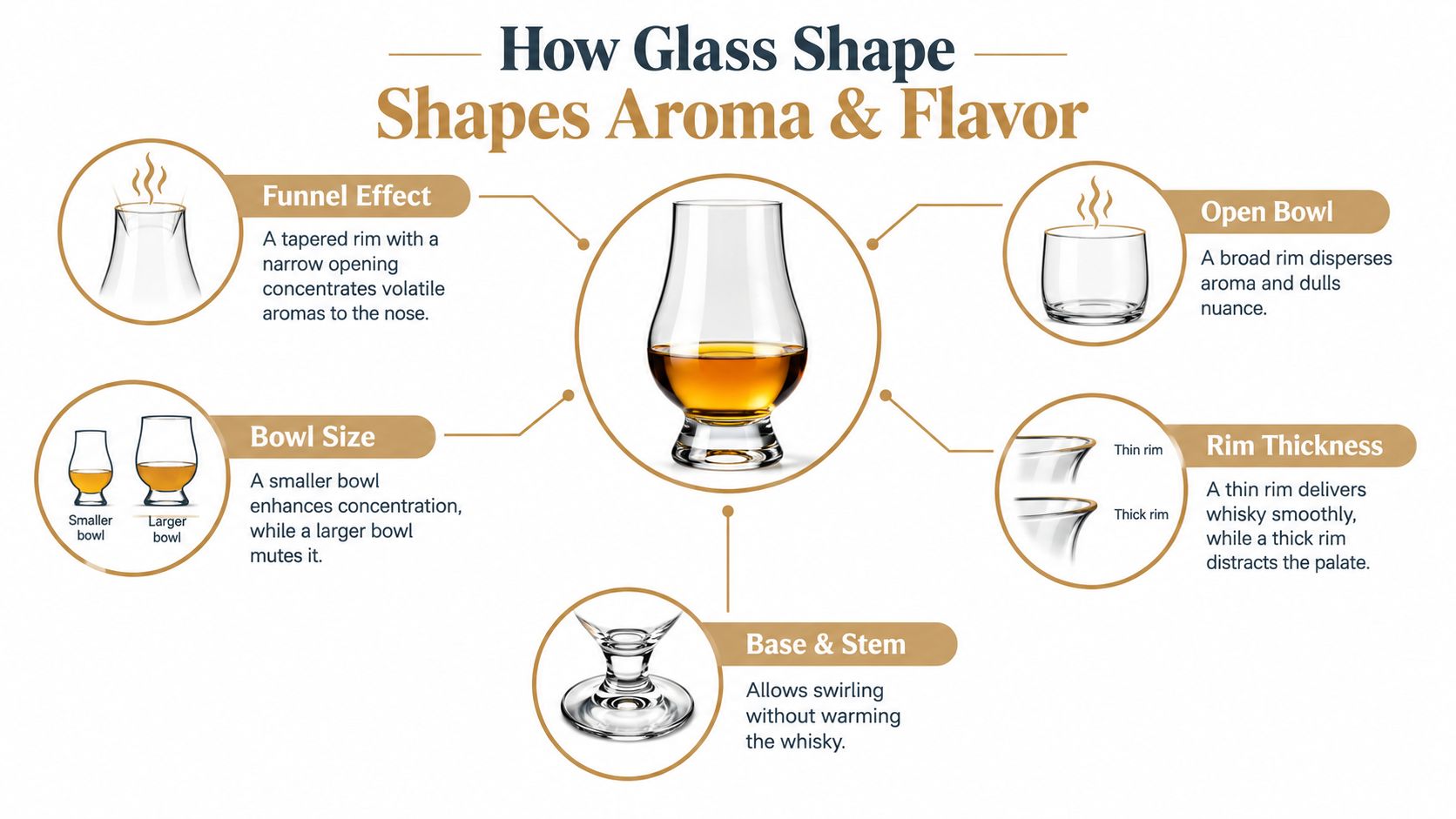
What your hand and lips notice
A thin rim tends to feel cleaner against the lip, while a thick edge can become part of the drinking experience in a less subtle way. A heavier base adds stability and can feel reassuring, particularly when the glass is used with ice. A stem or short foot lets you swirl without gripping the bowl directly, reducing the chance of warming the whisky with your hand.
For a closer look at how different shapes work in practice, compare this guide to the best glasses for Scotch whisky. The important point isn't that one vessel makes every Scotch better. It's that each shape emphasizes a different route to enjoyment, aroma concentration for tasting, openness and stability for casual service, or visual weight for gifting.
Key Features to Evaluate in Any Scotch Glass Set
Once you understand the sensory role of shape, shopping becomes less mysterious. Start by separating the glass families. Glencairn-style and tulip glasses prioritize aroma, rocks tumblers prioritize versatility, and stemmed options add control during swirling and formal tasting.
Material affects appearance and handling, but it shouldn't be confused with automatic flavor improvement. Clear crystal can make color and light more expressive, and a fine rim can make the pour feel refined. Standard glass may be the more practical choice for frequent use, especially when replacement cost and durability matter.
A practical comparison
| Glass Style | Best For | Aroma Focus | Material Note |
|---|---|---|---|
| Glencairn-style taster | Neat Scotch and structured tasting | High, because the bowl tapers toward the rim | Often available in clear glass or crystal |
| Tulip tasting glass | Nosing, whisky flights, and aroma comparison | High, with a focused opening | A thin rim supports a precise sip |
| Rocks tumbler | Ice, cocktails, and relaxed pours | Lower, because the opening is broad | A heavy base improves stability |
| Stemmed tasting glass | Swirling and formal evaluation | High, with less direct hand contact | Clarity and a fine rim support visual and sensory work |
| Crystal tumbler | Gifting and presentation | Moderate, depending on the shape | Facets and weight emphasize visual appeal |
Capacity also deserves attention. A larger vessel can look impressive but may encourage an oversized pour or leave the whisky sitting too broadly across the bowl. A compact tasting glass makes portion control and nosing more intuitive.
Look beyond the word crystal
“Crystal” can describe a premium finish, clarity, or a particular glass composition, but the label alone doesn't tell you how the glass will perform. Inspect the rim, the transition from bowl to opening, the flatness of the base, and whether the glass feels balanced when lifted.
Clarity helps you appreciate color, and a stable base reduces spills. If you're considering a decanter alongside the set, use the same practical mindset and review this guide to decanters for Scotch. A beautiful vessel still needs to suit the way you pour, store, and share whisky.
Shelf-check rule: Choose the glass whose shape matches the drink first. Treat decorative cutting, heavy packaging, and brand prestige as secondary considerations.
How to Choose a Scotch Glass Set for Tasting Versus Gifting
A tasting set and a gift set solve different problems. For tasting, your priority is aroma access and consistency. For gifting, the priority often shifts toward presentation, versatility, and a satisfying object to unwrap.
Start with the recipient's usual pour. If they drink Scotch neat and enjoy comparing aromas, choose narrow tapered glasses. The tulip shape gives each sample a similar path from bowl to nose, which makes side-by-side evaluation easier. A thin rim and clear bowl add to that focused experience.
If the person reaches for ice, makes whisky cocktails, or hosts casual drinks, a tumbler set may be more useful. The wider opening leaves room for ice and stirring, while the flat base offers confidence on a table or bar cart. It won't concentrate aroma like a dedicated taster, but it may earn more frequent use.
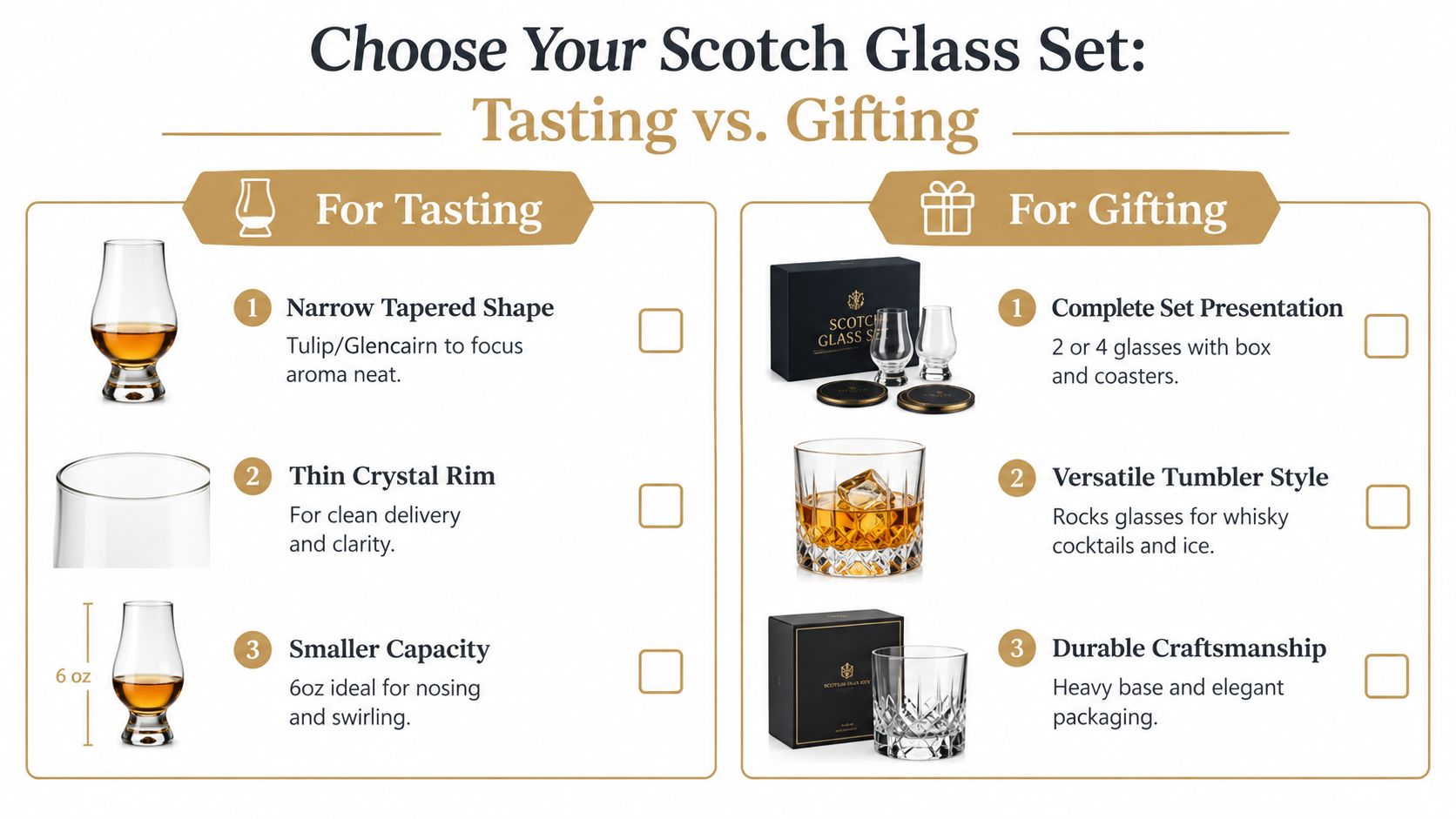
Match the set to the drinker
Use this decision path:
- For a curious beginner, choose a versatile set if you don't know whether the recipient prefers neat whisky or ice. A tumbler creates fewer rules and works across serving styles.
- For an enthusiast, choose Glencairn-style or tulip glasses that make nosing and comparison natural.
- For a host, prioritize matching pieces, stable bases, and a box that protects the glasses between occasions.
- For a design-focused recipient, crystal or cut-glass tumblers may deliver the strongest visual impact, even if aroma concentration isn't their main goal.
Market coverage places tumblers at about 34.5% share of the whiskey-glass market, according to Growth Market Reports. That helps explain why versatile sets remain a common default. They meet everyday needs, while premium crystal formats continue to attract buyers who care about gifting and at-home bar presentation.
Set size and presentation
A pair of glasses suits a couple or a quiet tasting. A larger matching group works better for hosting and guided comparisons. Packaging matters because a gift set should arrive ready to present, not like a collection of loose items gathered from different shelves.
For more gift-oriented ideas, see this guide to the best Scotch whisky gifts. A good gift doesn't need to announce itself as technical. It should make the recipient want to pour something, invite someone over, and start exploring.
If you're uncertain, buy for the person's ritual, not your own. The perfect tasting glass can sit unused if the recipient prefers a slow pour over ice.
Making Your Set More Enjoyable With American Craft Whiskey Pairings
Scotch glass sets often feature American craft whiskey brands, especially in curated gift collections. Retail examples include Balcones Texas Bourbon, Buffalo Trace Bourbon, Four Roses Bourbon, Elijah Craig, and Bulleit Rye, showing how whiskey gift sets frequently cross regional categories instead of limiting themselves to Scotch labels. Sip Whiskey's gift-set collection provides examples of that retail approach.
That mix creates an easy entry point for a new drinker. You can pour one whiskey into a tapered glass and another into the same style, then ask what changes in the aroma. The point isn't to guess a brand immediately. It's to notice whether the nose feels fruity, grain-forward, sweet, spicy, smoky, or oak-led.
American craft whiskey also brings a sense of place to the table. An industry overview connects the category with smaller, distinctive distilleries such as Westland in Seattle, Old Potrero in San Francisco, Smuggler's Notch in Vermont, and Bully Boy in Boston. This American craft-whiskey overview illustrates why these bottles fit naturally into exploratory tasting sets.
A beginner-friendly tasting ritual
Pour modest samples and keep the order simple:
- Smell first: Hold the glass by its base or stem and take a gentle sniff.
- Name what you notice: “Fruit,” “vanilla,” “pepper,” and “toast” are useful observations, not wrong answers.
- Taste slowly: Let the whisky move across the palate without chasing a perfect description.
- Record the finish: Note whether the ending feels short, warm, sweet, dry, smoky, or spicy.
- Reveal brands later: If you're tasting blind, keep the identity hidden until everyone has written a first impression.
Blind Barrels offers a quarterly blind tasting subscription with four samples from small American craft distilleries, tasting guidance for aroma, taste, and finish, and a reveal process that also supports bottle discovery. Used with a matching set, that format turns glassware into a shared exercise rather than a decorative purchase.
Caring for Your Scotch Glass Sets So They Last
Good care protects more than appearance. Clean, clear glass lets you inspect color, while an undamaged rim preserves the smooth contact that makes a tasting glass feel precise. Thin tasting glass deserves a slower routine than a sturdy everyday tumbler.
Hand-wash delicate glasses with warm water and a mild detergent. Avoid abrasive sponges, harsh cleaners, and sudden shifts between hot and cold water, which can stress glass and crystal. Hold the bowl gently rather than twisting the stem or pressing hard against the rim.
A simple care routine
- Rinse soon after use: Dried whisky residue is harder to remove and can leave a lingering smell.
- Wash one glass at a time: Support the bowl with one hand and clean with the other.
- Rinse thoroughly: Soap residue can interfere with the next pour's aroma.
- Dry carefully: Use a soft, lint-free cloth or allow the glass to air-dry upside down on a clean surface.
- Store with space: Keep rims from touching one another, and avoid stacking shapes that weren't designed to nest.
Never polish the inside aggressively. A soft cloth around the exterior is enough to remove water marks while reducing the chance of stress at the rim.
If you travel with a matching set or store tasting glasses away from the home bar, a protective leather glasses case can help separate the pieces and reduce contact with hard surfaces. Protection is especially useful for thin-rimmed tasting vessels, which are designed for sensory control rather than rough handling.
A Scotch glass set earns its place when you use it with purpose. Choose a tapered glass for aroma-led tasting, a tumbler for ice and everyday pours, or a presentation-focused set for gifting. Then wash, dry, and store each piece with the same care you'd give the whisky inside it.
Blind Barrels pairs guided blind tastings with four samples from small American craft distilleries, tasting notes, reveals, and a palate-scoring game. Visit Blind Barrels to turn your new Scotch glass set into a hands-on whiskey tasting experience.