

Diving into Scotch whisky for beginners can feel like a massive leap, but it all starts with one simple pour. The best way to think about it is as a passport to a world filled with rich history and complex flavors—a world designed to be explored, not just memorized. Consider this guide your friendly translator, here to make your first experience a genuine adventure.
Your Journey into Scotch Whisky Starts Here
Stepping into the world of Scotch can feel a little like trying to learn a new language. You hear all these strange words, see names you can't pronounce, and wonder where to even begin. But it doesn't have to be intimidating. We’re going to walk you through what makes this spirit so unique, explore the incredibly diverse flavors of Scotland, and show you how to taste it like a seasoned enthusiast. This is your starting point for building a confident palate.
What's really cool is that understanding Scotch traditions also unlocks an appreciation for great whisky everywhere, including the exciting world of American craft whiskey brands. The core principles of quality, aging, and regional character are pretty universal. Once you learn to pick out the subtle notes in a Highland single malt, you'll suddenly find it easier to identify similar complexities in a bottle from a small distillery in Texas or Colorado.
A Global Tradition Rooted in Scotland
The appeal of Scotch is truly a worldwide phenomenon. In fact, it's shipped out of Scotland at a staggering rate of 44 bottles every single second. That adds up to over 1.4 billion bottles exported annually to more than 160 markets, a testament to its enduring reputation for craftsmanship. You can discover more insights about the Scotch market and its global reach on cognitivemarketresearch.com. This massive scale just goes to show how a local Scottish tradition captured the world's imagination.
The best way to learn about Scotch is by tasting it. Forget the complicated rules and intimidating labels for a moment. Your own palate is the most important guide you have, and this journey is all about discovering what you actually enjoy.
Tips for New Whiskey Drinkers
As you begin, keeping a few simple tips in mind can make the whole experience more enjoyable and way less overwhelming:
- Start with Lighter Styles: Don't feel pressured to jump straight into the smokiest, most intense bottles. One of the best tips for new whiskey drinkers is to look for whiskies from the Lowlands or Speyside regions. These are often lighter, fruitier, and much more approachable for a newcomer.
- Don't Be Afraid to Add Water: A few drops of room-temperature water can dramatically open up a whisky, and it's what the pros do. It dials back the alcohol burn and allows more subtle aromas and flavors to come forward. It’s like turning up the volume on the whisky's personality.
- Trust Your Taste: There are no right or wrong answers in tasting. Seriously. If you taste green apple, that's what you taste! The goal here is to build your own flavor vocabulary, not to perfectly match someone else's tasting notes.
What Gives a Whisky the Right to Be Called Scotch
Not just any whisky can slap "Scotch" on its label. Think of it like Champagne from France or real Parmesan from Italy—it's a legally protected name that guarantees a certain standard of quality, origin, and tradition.
For a spirit to earn that prestigious title, it has to follow a very strict rulebook. This isn't just about geography; it's a legal framework that ensures every single bottle is authentic. These regulations are precisely why Scotch has kept its stellar reputation for centuries, dictating everything from the ingredients to how long the whisky must sleep in a barrel before it's ready.
The Legal Blueprint of Scotch
So, what are these non-negotiable rules? A whisky must tick several crucial boxes to legally call itself Scotch. It's like a passport that needs every stamp before it's considered official.
Here are the absolute must-haves:
- Made in Scotland: The entire show—mashing, fermentation, distillation, and maturation—has to happen within Scotland's borders. No exceptions.
- Grains and Water: It must be made from only water and cereal grains. If it's a single malt, that grain has to be 100% malted barley.
- Aged in Oak: The spirit has to mature in oak casks for a bare minimum of three years. This is where the magic happens, developing much of the flavor and deep color.
- Minimum Strength: It can't be bottled at less than 40% alcohol by volume (ABV).
This infographic breaks down the essential parts of the Scotch whisky journey, from its core identity to the flavors you'll discover and how to properly taste it.
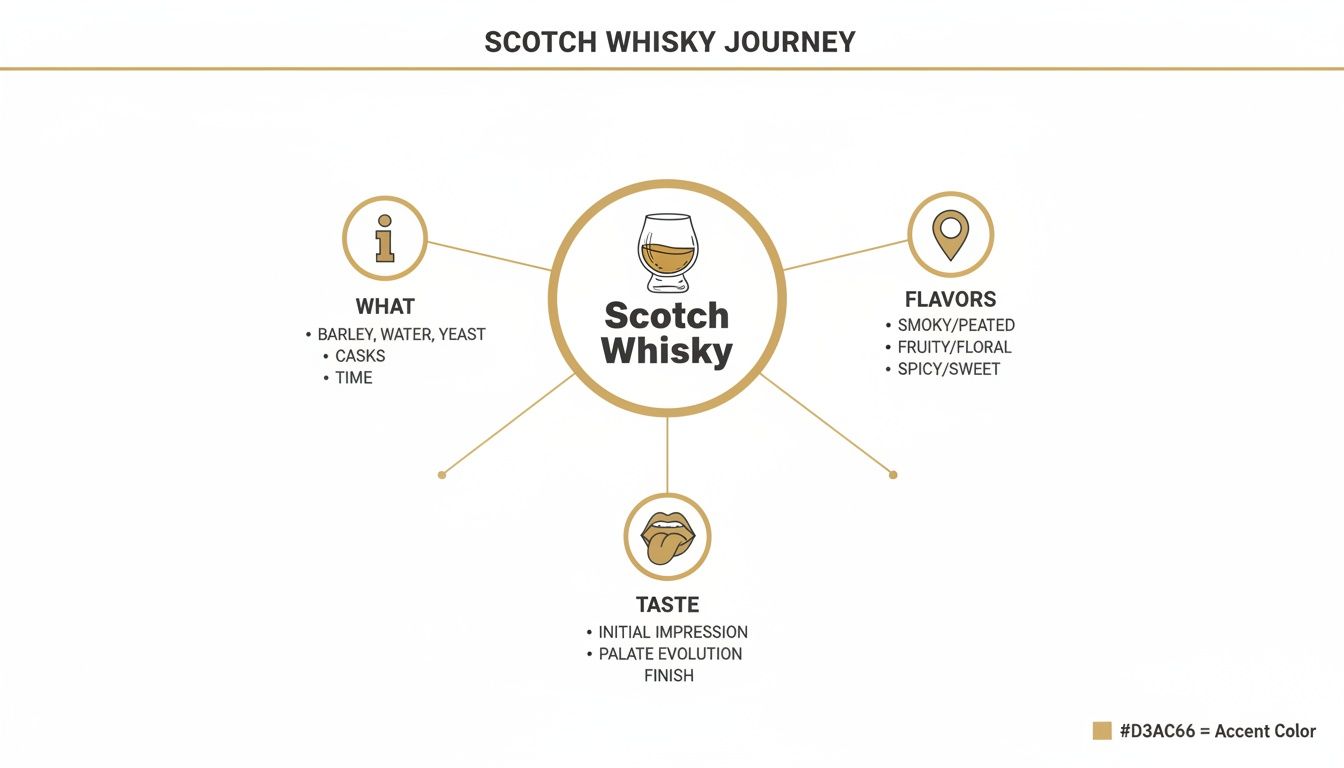
As you can see, understanding what makes a Scotch, where its flavors come from, and how to taste it are the three pillars for any beginner starting their journey.
Understanding the Five Official Types
The Scotch world is neatly divided into five legally defined categories. Getting a handle on these is your first big step toward reading a label like a pro and knowing exactly what you're buying.
Below is a quick rundown to get you started.
| Scotch Type | What It Means | Common Flavor Profile |
|---|---|---|
| Single Malt Scotch | Made from 100% malted barley at a single distillery using pot stills. | Reflects the unique character of its home distillery—can be smoky, fruity, floral, or rich. |
| Single Grain Scotch | Also made at a single distillery, but can include other grains like corn or wheat. | Typically lighter, sweeter, and smoother than single malts. Think vanilla and toffee. |
| Blended Scotch | A mix of one or more single malts with one or more single grain whiskies. | The most common type; designed for balance and consistency. Often smooth and approachable. |
| Blended Malt Scotch | A blend of single malt whiskies from two or more different distilleries. | Offers complex flavors by combining the distinct styles of multiple malt producers. |
| Blended Grain Scotch | A blend of single grain whiskies from two or more different distilleries. | The rarest category. Known for being light, sweet, and exceptionally smooth. |
While Single Malt often gets all the glory, Blended Scotch is the engine of the industry, representing the vast majority of sales worldwide. The art of the blender is to create a consistent, balanced flavor profile year after year.
Each type offers a completely different experience. Digging into the nuances of how they're made is a fascinating rabbit hole. For a deeper dive, you can learn more about what makes whisky in our detailed guide.
Discovering Scotland's Diverse Flavor Regions
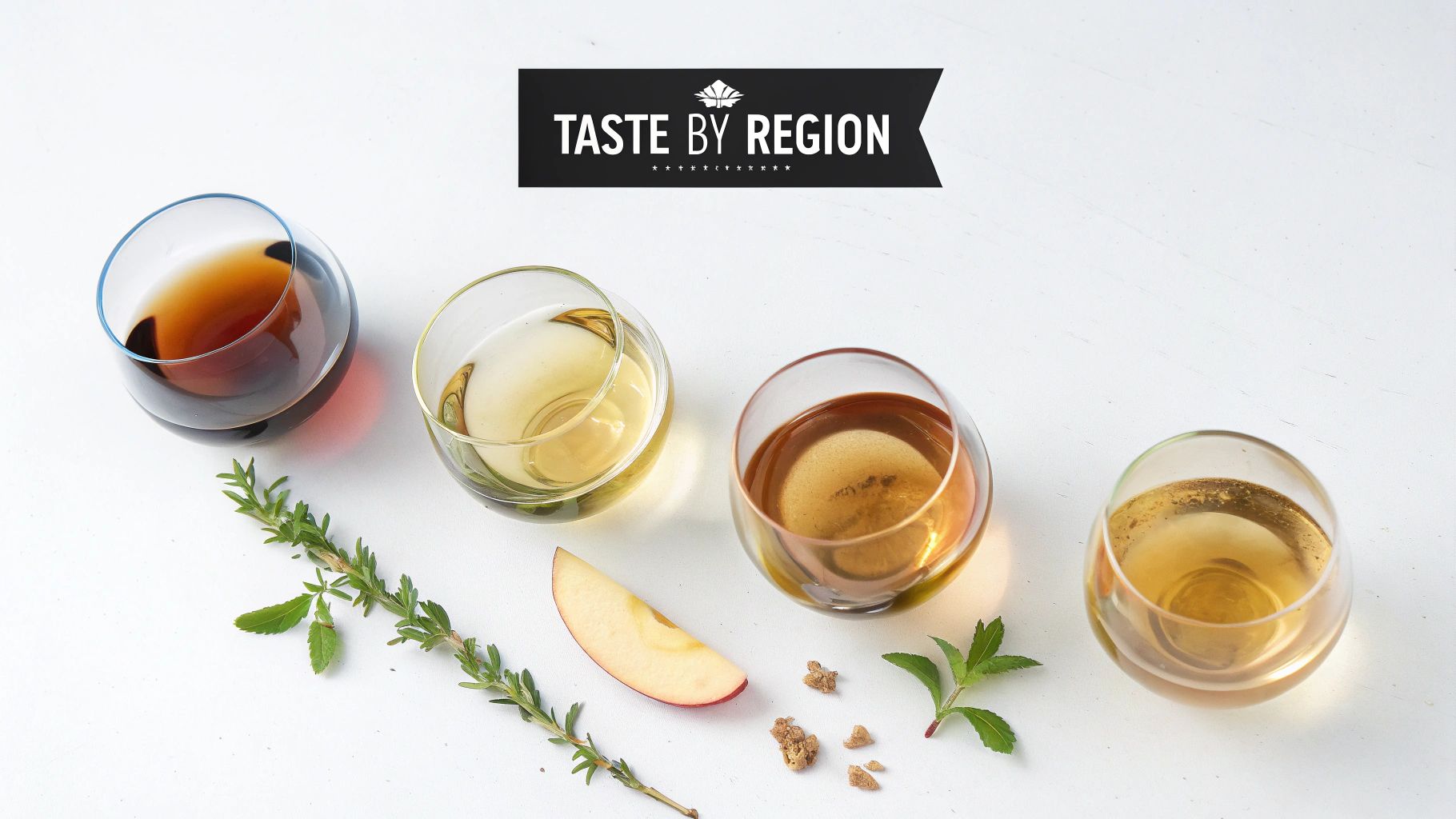
To really get your head around scotch whiskey for beginners, it helps to think of Scotland as a country with distinct flavor zip codes. The local environment—everything from the salty sea air to the sheltered inland glens—leaves a unique fingerprint on the spirit. Just like terroir shapes wine, the specific region where a Scotch is born profoundly influences its taste.
Now, these regions aren't a set of rigid, unbreakable rules, but they are an absolutely fantastic flavor map. Knowing their general characteristics is like having a cheat sheet to find a style you’ll genuinely love, and it’s the perfect way to start navigating the liquor store shelves with some real confidence.
Speyside: The Orchard of Scotland
Speyside is the most densely populated whisky region in Scotland, packing in over half of the country's distilleries. If you're just starting out, this is probably the best place to begin your tasting adventure.
Think of Speyside whiskies as the liquid equivalent of a stroll through an apple orchard on a sunny day. They’re famous for being:
- Fruity: Often bursting with notes of fresh apple, pear, and other orchard fruits.
- Elegant: Known for their smooth, refined, and incredibly approachable character.
- Sweet: Frequently carrying hints of honey, vanilla, and caramel, often from aging in ex-bourbon or sherry casks.
These drams are typically light and very rarely heavily smoked, which makes them exceptionally welcoming for a palate that's new to Scotch. It’s the classic style that really lets the pure, malty heart of the spirit shine through.
Islay: The Smoky Coastal Powerhouse
Okay, let's take a trip to the rugged, wind-swept island of Islay (pronounced "eye-luh"). This region is famous—or infamous, depending on who you ask—for one thing above all else: peat. Peat is basically decomposed vegetation that’s used to dry the barley, and it imparts a powerful, smoky flavor that is absolutely unmistakable.
Islay whiskies are bold, intense, and not for the faint of heart. They often deliver a full-sensory experience packed with:
- Smoke: From gentle campfire embers to a full-on, medicinal smoke bomb.
- Maritime Notes: Flavors of sea salt, brine, and even seaweed are common here.
- Complexity: Beneath that wall of smoke, you’ll often find surprising layers of flavor, from dark chocolate to zesty citrus.
If you’re someone who loves smoky barbecue or a rich cigar, you might just fall head over heels for Islay malts. To get a deeper understanding of this unique flavor, check out our guide on what is peaty scotch and why it's so beloved.
Tip for New Drinkers: Curious about peat but a little intimidated? I get it. Try an Islay whisky in a cocktail first. A Whisky Sour or a Penicillin can beautifully balance the smoke with sweet and citrus elements, making it much more approachable.
The Highlands: Diverse and Robust
The Highlands is a massive and geographically diverse region, and its whiskies are just as varied. You can pretty much find a little bit of everything here, from rich and sweet to lightly smoky and complex.
Because the area is so huge, there’s no single defining characteristic. That said, many Highland malts are known for being robust and full-bodied. You might find whiskies that are heathery and floral, while others are nutty, spicy, or carry just a gentle wisp of smoke—a perfect middle ground between Speyside's fruitiness and Islay's intensity. This incredible diversity makes the Highlands an exciting region to explore as your palate develops.
How to Properly Taste Scotch Whisky
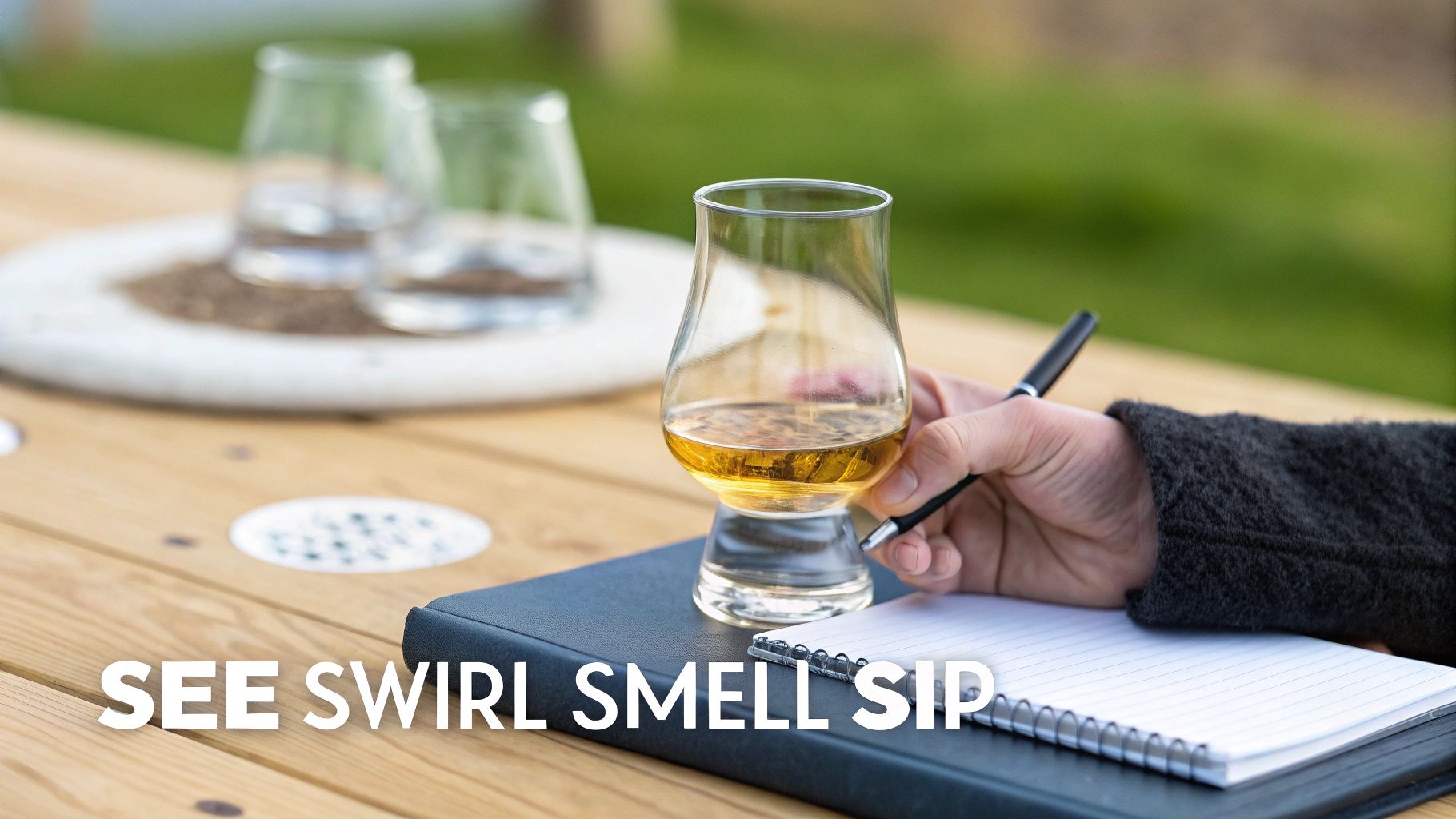
Tasting Scotch isn't about following a rigid set of rules; it's an act of discovery. Forget everything you think you know about some stuffy, "proper" whisky etiquette. This is simply about training your senses to notice the incredible depth of character hiding in your glass.
We'll walk you through a simple, four-step process that professionals use. Think of it less as a formal procedure and more as a mindful way to appreciate the spirit. It's a method that helps you slow down, pay attention, and ultimately figure out what you truly enjoy.
Step 1: See and Swirl
First things first: just look at the whisky. Hold your glass up to the light and take in its color. Is it pale straw, a rich gold, or a deep, brooding amber? The color can drop hints about the type of cask it was aged in and how long it spent there.
Now, give the glass a gentle swirl. Watch as the liquid coats the sides and then slowly drips back down. These drips are called "legs" or "tears." As a general rule, thicker, slower-moving legs can suggest a higher alcohol content or a more viscous, oily texture in the mouth.
Step 2: Smell the Aromas
Nosing the whisky is arguably the most important step. Your sense of smell is responsible for the vast majority of what you perceive as flavor, so don't skip this part!
Tip for New Drinkers: Don't stick your nose deep into the glass and take a huge whiff—you'll just get a blast of alcohol that singes your nostrils. Instead, hold the glass a few inches from your face and gently waft the aromas toward you. Keep your mouth slightly open as you smell; this helps circulate the air and allows you to pick up more subtle scents.
What do you notice first? Is it fruity like crisp apples or pears? Maybe it's sweet like vanilla and caramel, or perhaps you detect a wisp of smoke or a hint of spice. There are no wrong answers here.
Step 3: Sip and Savor
Finally, it's time to taste. Take a small sip—just enough to coat your tongue. Let the whisky rest on your palate for a few seconds before swallowing.
Notice the initial flavors that hit you, then pay attention to how they develop and change. The experience from that first sip to the lingering aftertaste is called the "finish." Is it short and sharp, or does it linger with a warm, spicy sensation? A quality whisky will often evolve on your palate, revealing new layers of complexity.
If you're looking to go deeper, our comprehensive guide on tasting Scotch whisky offers even more techniques to try.
One of the best tips for any new whiskey drinker is to add a few drops of room-temperature water. This simple act can dramatically change the whisky, softening the alcohol burn and unlocking hidden layers of aroma and flavor. Experiment with and without water to see how the profile shifts. It’s all about training your palate to identify what you enjoy, free from the influence of a fancy label.
Alright, you're ready to buy your first bottle of Scotch. This is where the real fun starts. Staring at a wall of whiskies can feel like a pop quiz you didn't study for, but don't worry—a few simple pointers will have you walking out with a great bottle.
Think of your first purchase as setting a baseline, not passing a final exam. The best move is to grab a classic bottle that defines a core regional style. It gives you a solid reference point for everything else you'll try down the road. It’s like learning your primary colors before you start mixing your own.
Getting Started: A Few Great First Bottles
To cut through the noise, here are a few accessible and well-loved single malts that are perfect introductions to the world of Scotch whisky for beginners:
- For a Fruity & Elegant Start (Speyside): You can't go wrong with The Glenlivet 12 or Glenfiddich 12. Both are famously smooth and approachable, with a ton of apple, pear, and honey notes.
- For a Rich & Complex Experience (Highlands): Give Glenmorangie The Original 10 Year a try. It’s aged in ex-bourbon casks, which gives it these wonderful vanilla and citrus flavors without any intimidating smoke.
- For a Touch of Coastal Salt & Smoke (West Highland): Oban 14 strikes a beautiful balance. You get rich fruitiness, but it’s paired with a gentle wisp of sea salt and smoke—the perfect bridge to more intense styles.
Busting a Few Myths That Hold People Back
Navigating the world of Scotch gets a lot easier once you ditch a few common misconceptions. These ideas tend to intimidate newcomers, but the reality is much more straightforward.
The biggest myth out there is that older is always better. An age statement just tells you the age of the youngest whisky in the bottle. Sure, older whiskies can be wonderfully complex, but plenty of younger ones are vibrant, packed with flavor, and genuinely exciting. Age is just one characteristic, not a guarantee of quality.
Another one is that single malt is the only "real" Scotch. That couldn't be further from the truth. High-quality blended Scotch whiskies are masterpieces of balance and consistency, often created by blenders with decades of experience. Frankly, they're often smoother and more approachable for beginners.
The "best" whisky isn't the oldest or most expensive one. It’s the one you enjoy drinking, prepared exactly how you like it. Your own palate is the only expert that really matters.
And finally, remember that the skills you build tasting Scotch will serve you well elsewhere. As American single malt whiskey continues to gain serious traction, you’ll find your ability to pick out notes of oak, fruit, and spice in a Scotch helps you appreciate the unique character of American craft whiskey brands. It’s all part of the same delicious journey.
You’ve covered the basics of regions, styles, and how to taste. So, what's next? This is where the real fun begins: letting your own palate lead the way.
The best education you can get happens when you ignore the label and focus on what's actually in the glass. This is the power of tasting without bias.
When you strip away the influence of a fancy bottle, an impressive age statement, or slick marketing, you force your senses to be the only judge. It’s hands-down the fastest way to figure out what you genuinely enjoy, turning you from a curious beginner into a confident enthusiast.
From Scotland to American Craft
This method of discovery isn't just for Scotch, either. Once you start honing your palate, you'll be amazed at how well you can navigate the exciting world of American craft whiskey brands. The skills you build identifying notes in a Speyside single malt will directly translate to appreciating a complex American single malt. Suddenly, every sip, regardless of its origin, becomes a valuable lesson.
There's a reason the single malt category is exploding in popularity. Single malt Scotch is the hottest segment in the Scotch whisky world, racing ahead with a projected 6.51% CAGR through 2030. This isn't just a random trend; it shows that drinkers everywhere are searching for authentic, unique flavors. For a beginner, there’s never been a better time to jump in. You can read the full research about the growing single malt market if you want to dive deeper into the numbers.
Your palate is your most honest guide. When you taste without knowing the brand or price, you discover your true preferences, not what you think you should like. This is the key to building real confidence.
Ultimately, your journey is all about staying curious. Whether you're circling back to a classic Scotch you tried months ago or sampling a brand-new craft spirit, this mindful approach ensures your education never stops. Every pour becomes another step on a lifelong adventure.
Got Questions About Scotch?
As you dive into the world of Scotch, you're bound to have some questions. Everyone does. Getting a handle on these common curiosities is the best way to feel more comfortable and get more out of every glass.
What's the Real Difference Between Scotch and Whiskey?
Here's the classic line you'll hear: all Scotch is whiskey, but not all whiskey is Scotch. At its core, the difference comes down to geography and a strict set of rules. For a spirit to legally be called "Scotch," it has to be made and matured in Scotland for a minimum of three years in oak barrels. That’s non-negotiable.
Other countries have their own rulebooks. Bourbon, for instance, has to be made in the U.S. with at least 51% corn. Meanwhile, tons of exciting American craft whiskey brands are carving out their own unique paths. Just think of "whiskey" as the big, sprawling family tree and "Scotch" as a very specific, well-defined branch with deep roots.
Should I Add Water or Ice to My Scotch?
You absolutely should—if that's how you like it. Don't let anyone tell you there's a "right" way to drink it. One of the best tips for new whiskey drinkers is simply to experiment and find out what works for you.
Adding a few drops of room-temperature water can be a game-changer. It can dial back the alcoholic punch and unlock a whole new layer of aromas and flavors. Even master blenders do this! Ice, on the other hand, cools the drink down and dilutes it over time, which can be really refreshing. My advice? Try it neat first, then add a tiny bit of water and see how it changes.
What Does the Age on the Bottle Actually Mean?
When you see an age statement on a bottle, like "12 Years Old," it's telling you the age of the youngest whisky that went into that bottle. If it's a blend of 12-year-old and 25-year-old whiskies, the label has to say 12.
While older whiskies often pick up more complexity and smoothness from that extra time in the barrel, age isn't a direct stand-in for quality. There are plenty of phenomenal younger whiskies out there that are bright, punchy, and full of character. Age is just one part of the story, not the whole book.
What's the Deal with "Peated" Scotch? And Will I Like It?
"Peated" means that peat—basically decomposed, boggy plant matter—was burned to dry the barley before it was turned into whisky. This process infuses the grain with a powerful smoky, earthy, and sometimes medicinal character. The island of Islay is the undisputed king of heavily peated Scotch.
So, will you like it? If you're a fan of smoky flavors—think campfires, Lapsang souchong tea, or good barbecue—you're a prime candidate. If you're on the fence, I'd suggest starting with a lightly peated whisky from a region like the Highlands to dip your toes in.
Ready to figure out your own whiskey tastes without being swayed by a fancy label? Blind Barrels sends you curated, unlabeled samples from some of America's most exciting craft distilleries. It's a fun and eye-opening way to let your palate call the shots.
Start your blind tasting adventure today at https://www.blindbarrels.com.