

At its core, whisky is a beautiful transformation.It’s what happens when you take simple ingredients like grain, water, and yeast, run them through a bit of science and art, and then let them rest in wooden barrels. Think of it as a recipe with five key elements: grain, water, yeast, wood, and time. The real magic, though, is how tweaking any one of these can create the staggering diversity of flavors you find in every bottle.
The Soul of Whisky A Beginner Introduction
Welcome to the endlessly fascinating world of whisky. Whether you're staring down a wall of bottles at the liquor store or trying to decipher a bar menu, the sheer variety can feel like a lot. What really separates a smoky Islay Scotch from a sweet, caramel-rich bourbon? How can the same handful of ingredients produce spirits that taste worlds apart?
This guide is here to demystify the entire process, from the grain in the field to the spirit in your glass. We'll explore the five essential pillars that define every drop of whisky, giving you a simple but solid framework for your journey. Getting a handle on these fundamentals is the first real step toward appreciating the craft behind your favorite dram and exploring new styles with confidence.
The Five Pillars of Whisky
Imagine these five elements as a band. Each instrument plays a critical role, and changing one player or even just their tempo can alter the entire character of the song.
- Grain: This is the foundation, providing the sugars needed for fermentation. The choice of grain—be it corn, barley, rye, or wheat—sets the stage for the spirit's initial flavor profile.
- Water: The unsung hero. Water is essential for mashing and later for proofing the spirit down. Its unique mineral content can subtly influence the final taste in ways you might not expect.
- Yeast: These tiny organisms are the workhorses. They’re responsible for converting that sugary water (called wort) into alcohol, creating crucial flavor compounds along the way.
- Wood: The barrel isn’t just a container; it's an active ingredient. The cask imparts color, complex aromas, and a huge portion of the final flavor during the aging process.
- Time: This is the patient maturation that mellows a harsh, young spirit and allows all the different flavors from the grain, distillation, and wood to integrate and evolve into something truly special.
Tip for New Drinkers: Remember that every whisky tells a story about where it came from. An American Single Malt from a craft distillery like Westward Whiskey often tells a bold story of new American oak and regional grains, while a classic Scotch might whisper tales of old sherry casks and salty sea air.
With that in mind, let's dive deeper into each of these pillars. By the end, you'll have a rock-solid foundation of whisky knowledge.
From Field to Fermenter: The Foundational Ingredients
Long before a single drop of whisky ever sees the inside of a barrel, its story begins with three humble, yet absolutely essential, ingredients: grain, water, and yeast. Think of these as the primary colors on a painter's palette. The way they’re chosen, handled, and combined sets the entire tone for the masterpiece that’s yet to come.
If you want to truly understand what makes whisky, you have to start right here, in the fields and streams. Every flavor you'll eventually taste—from the sweetness of corn to the spice of rye—is born from these simple elements. They are the foundational building blocks that distillation and maturation will later shape into something extraordinary.
The Heartbeat of Whisky: Grain
Grain is the very soul of whisky. It provides the starches that are destined to become sugars and, finally, alcohol. The specific grain used has the single biggest impact on a whisky’s base character, much like different flours determine the kind of bread you bake. A corn-based bread is sweet and crumbly, while a rye bread is dense and spicy—whisky is no different.
The scale of this first step is massive. Global whisky production consumes hundreds of millions of tonnes of cereals every year. To put that in perspective, Scotch distilleries might report their malt intake in the low hundreds of thousands of tonnes annually, while America's biggest bourbon states measure their corn usage in the millions. Water is just as crucial, needed for mashing, cooling, and dilution. A single large Scotch distillery can easily use tens of thousands of liters of water per day during peak production. Across major markets like Scotland, the U.S., and Japan, that adds up to many millions of cubic meters of freshwater each year. For more on these market trends, you can see reports on sites like ohbev.com.
Tip for New Drinkers: A great way to start identifying grain flavors is by comparing a bourbon (which is corn-forward) with a rye whiskey. Notice the bourbon's inherent sweetness versus the rye's peppery spice. This simple side-by-side tasting can be an "aha!" moment for your palate.
The four primary grains each bring a unique voice to the choir:
- Corn: Delivers a distinct sweetness, with classic notes of vanilla, caramel, and a rich, oily mouthfeel. It’s the backbone of American Bourbon.
- Malted Barley: The cornerstone of Scotch and so many craft whiskies, barley brings malty, biscuity, and nutty flavors. The malting process—essentially tricking the grain into germinating to activate enzymes—is vital for converting its starches into fermentable sugars.
- Rye: Known for its bold, assertive character, rye contributes spicy notes of black pepper, cinnamon, and mint. It’s the star player in American Rye Whiskey.
- Wheat: Often used as a secondary "flavoring" grain, wheat provides a softer, gentler profile with notes of honey, bread dough, and a silky texture. "Wheated bourbons" are prized for this exact smooth character.
Most whiskies aren't made from just one grain; they use a specific recipe, known as a "mash bill," that combines several. You see this creativity on full display with American craft distillers like FEW Spirits in Illinois, who experiment with unique grain combinations to create truly distinct spirits. You can learn more about how these recipes work by exploring our guide to the bourbon grain bill.
The Unsung Heroes: Water and Yeast
While grain gets most of the glory, water and yeast play roles that are just as critical, even if they're a bit more subtle. Water is used throughout the entire process, and its mineral content—or lack thereof—can absolutely influence the final spirit. Scotland's famously soft water is said to contribute to the character of its whiskies. Meanwhile, the limestone-filtered water of Kentucky is prized for making bourbon because it's rich in minerals and free of iron, which can ruin the taste.
Finally, there’s yeast—the microscopic magician. Its main job is to eat sugar and produce alcohol, but it does so much more. During fermentation, different yeast strains create a huge range of compounds called esters, which are responsible for many of the fruity and floral notes in whisky. Think green apple, banana, pear, or rose petals. Distillers guard their proprietary yeast strains like treasure, as they are a key part of what makes their distillery's flavor signature unique.
The Alchemy of Distillation and Maturation
Once the grain, water, and yeast have done their initial dance, we’re left with a cloudy, low-alcohol liquid called "wash." Think of it as a simple, rustic beer. It holds all the raw potential of whisky, but it’s still miles away from the finished product. To get there, it needs to go through two of the most critical transformations in its life: distillation and maturation.
Distillation is all about concentration. Just like simmering a sauce to deepen its flavors, we heat the wash to separate the delicate alcohol and desirable flavor compounds from the water. This step is what turns a simple fermented grain mash into a true spirit, ramping up the proof and carving out its essential character.
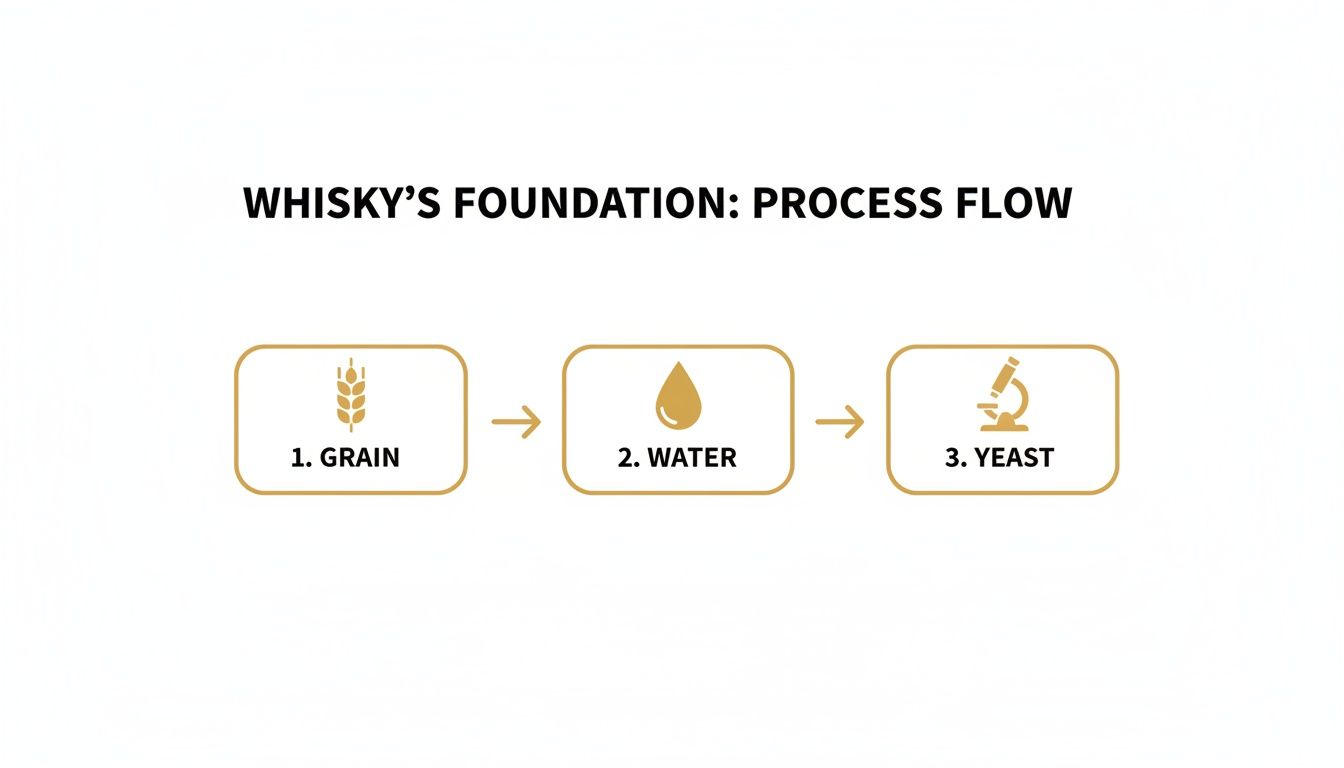
These three humble ingredients are the starting line for every whisky on the planet. From here, the real artistry begins.
The Art of the Still
The distillation process happens inside a still, which is almost always made of copper. That’s not just for looks; the copper plays a crucial chemical role, reacting with the vapor to strip out harsh sulfur compounds, effectively smoothing out the spirit before it ever sees a barrel.
The shape and size of the still have a massive say in how the final whisky tastes. There are two main designs you'll encounter:
- Pot Stills: These are the classic, onion-shaped copper stills you probably picture when you think of old-world distilling. They work in batches and are intentionally inefficient, allowing heavier, oilier, and more flavorful compounds to make their way into the final spirit. This produces a whisky with a richer body and more complex character, which is why pot stills are required for Single Malt Scotch.
- Column Stills: Also known as Coffey or continuous stills, these are towering, industrial columns that can run nonstop. They are incredibly efficient at stripping out almost everything but pure alcohol, yielding a much lighter, cleaner, and higher-proof spirit. Most American bourbons and ryes begin their life in a column still.
The magic really happens during the interaction between the vapor and all that copper. A tall, slender still neck creates more reflux—where vapor cools, condenses, and falls back down to be re-distilled. This results in a lighter, more delicate spirit. A short, squat still, on the other hand, produces a heavier, more robust spirit. To get a better handle on how this works, you can explore the key differences between pot stills and column stills in our deep-dive article.
Maturation: The Dialogue With Wood
Right off the still, the spirit—now called "new make"—is crystal clear, fiery, and pretty aggressive on the palate. It's not legally whisky yet. To earn that title, it has to spend years maturing in a wooden cask.
This isn't just storage. It's a living, breathing process where the barrel is responsible for 100% of the whisky's color and a huge chunk—some say up to 70%—of its final flavor. The cask is where the spirit develops its soul.
As the seasons change, the barrel literally breathes. Warmer temperatures cause the wood to expand, pushing the spirit deep into its pores. When it cools, the wood contracts, pulling the spirit back out. This slow, steady conversation between spirit and wood accomplishes three critical things:
- It Adds Flavor: The wood itself gives us those classic notes of vanilla, caramel, coconut, and baking spice.
- It Removes Flavor: A char layer on the inside of most barrels acts like a charcoal filter, mellowing the spirit and stripping out harsh, undesirable compounds.
- It Creates New Flavors: Over time, the spirit, wood, and trace amounts of oxygen interact to create complex new compounds called esters, which are responsible for many of the fruity and floral notes in a mature whisky.
Whisky barrels come in all shapes and sizes, and what they held before—or if they're brand new—has a huge impact on the final spirit. Here's a quick look at how different casks shape the liquid inside.
How Different Casks Shape Whisky Flavor
| Cask Type | Wood Origin | Common Previous Contents | Key Flavors Imparted |
|---|---|---|---|
| Ex-Bourbon Barrel | American White Oak | Bourbon Whiskey | Vanilla, Caramel, Coconut, Toasted Oak, Honey |
| Sherry Butt | European or American Oak | Oloroso or PX Sherry | Dried Fruits (Raisins, Figs), Nuts, Spice, Chocolate |
| Port Pipe | European Oak | Port Wine | Red Berries, Plum, Dark Chocolate, Spices |
| New Charred Oak | American White Oak | None (Virgin Oak) | Strong Oak, Toffee, Brown Sugar, Intense Spice |
This is just scratching the surface, but it shows how a distiller's choice of wood is one of the most important decisions they make.
The Angel's Share and the Influence of Climate
During its long rest in the barrel, a small amount of whisky evaporates right through the wood. This lost portion is beautifully known as the "angel’s share." On average, distillers lose about 2% of their barrel's volume each year, but that number can change dramatically based on the local climate.
In cool, damp Scotland, alcohol evaporates faster than water, so the proof of the whisky slowly drops over time. But in the blistering heat of Kentucky or Texas, the opposite happens. Water evaporates more quickly, causing the proof inside the barrel to actually rise as it ages.
This is why a Texas whisky from a distillery like Balcones can develop an incredibly deep and complex flavor profile in just a few years—the intense heat supercharges the maturation process, accelerating that conversation between the spirit and the oak.
A Global Tour of Regional Whisky Styles
We’ve covered the raw ingredients and the magic of distillation and maturation. Now, let's see how it all comes together on the world stage. Think of the rules—grain types, still shapes, cask choices—as a language. The basic grammar is the same everywhere, but local dialects, accents, and slang create beautifully distinct identities.
This is what makes a smoky, medicinal Islay Scotch and a sweet, vanilla-forward Kentucky Bourbon seem like they're from different planets, even though they share the same fundamental DNA. Each region has its own legally protected "dialect," a set of rules governing what makes their whisky unique. This global diversity is a massive part of the spirit's appeal and fuels a colossal international market.
Whisky is a true powerhouse in the global spirits industry. Depending on who you ask, market analyses for 2024-2025 peg its value anywhere from US$61 billion to US$108 billion, with steady growth projected at 4-6% annually. Scotland, Japan, and the United States lead the charge. In 2024, the U.S. alone accounted for roughly US$1.53 billion, or about 10.4%, of the world's total export value. It's a staggering number that shows just how much impact a few key regions can have. If you want to dive deeper, you can discover more insights about this global whisky trade and its key players.
Let's start our tour in the heart of American whiskey country.
American Whiskey: The Spirit of Innovation
American whiskey is all about bold flavors and a spirit of boundary-pushing creativity, anchored by a few landmark styles.
- Bourbon: America’s native spirit. It must be made from a mash bill of at least 51% corn, which is where its signature sweetness comes from. It also has to be aged in new, charred oak containers. This is the secret sauce, the reason it develops such deep notes of caramel, vanilla, and baking spice so quickly. While you can technically make it anywhere in the U.S., its soul lives in Kentucky.
- Rye Whiskey: The spicy counterpoint to bourbon. Following a similar rule, Rye must contain at least 51% rye in its mash bill. This grain delivers a distinctly peppery, sometimes minty character that's a world away from corn's sweetness. It’s a classic style that has seen a massive, well-deserved comeback.
Beyond these two giants, the American craft whiskey movement is where the real experimentation happens. Distillers are playing with everything—different grains, unique barrel finishes, and regional climates—to create entirely new flavor profiles. A fantastic example is Corsair Distillery in Tennessee, a team known for their wildly innovative use of grains like quinoa and smoked barley.
Tip for New Drinkers: Want to understand the American whiskey spectrum fast? Try a classic bourbon like Maker's Mark (a softer "wheated" bourbon) alongside a spicy rye like High West Double Rye!. The difference is immediate and will teach you a ton about your own palate.
Scotch Whisky: A Tale of Two Styles
Hop across the Atlantic to Scotland, and you’ll find a landscape defined by centuries of tradition. Scotch Whisky must be made in Scotland from malted barley (and other whole grains for blends) and aged for a minimum of three years in oak casks. That's the law.
The two most important categories to get your head around are:
- Single Malt Scotch: This is the style that gets all the glory. "Single" means it comes from just one distillery, and "Malt" means it's made from 100% malted barley. It must be distilled in traditional copper pot stills, resulting in a rich, complex spirit that is a pure expression of its home.
- Blended Scotch: Don't sleep on blends—they make up over 90% of all Scotch sold worldwide. It's a masterful combination of one or more single malts with various grain whiskies (which are lighter spirits made from other grains in a column still). The art of blending is all about creating a consistent, smooth, and approachable whisky.
Irish and Japanese Whisky: Global Icons
While America and Scotland are titans, other regions are producing world-class whiskies with their own distinct personalities.
Irish Whiskey is often praised for its exceptional smoothness. Traditionally, this comes from triple distillation (most Scotch is double distilled), which creates a lighter, cleaner spirit. While it can be made from malted barley, it’s also famous for using unmalted barley in the mash, which lends a creamy mouthfeel and a spicy, fruity character.
Finally, Japanese Whisky has earned a stellar global reputation for its incredible precision, balance, and elegance. The distillers were inspired by Scotch traditions but have since perfected the art of blending, paying meticulous attention to every single detail, from water purity to cask selection. The result is a whisky that is often complex yet harmonious, with a delicate and refined flavor profile that continues to sweep international awards.
The Final Touches: From Cask to Bottle
A whisky’s time in the barrel is where it finds its soul, but the journey isn’t over when it leaves the wood. The final steps before bottling are what truly refine its character, polish its edges, and prepare it for your glass. These crucial processes are what turn a cask-strength spirit into a beautifully balanced final product.
Think of it like a chef plating a dish. The ingredients are cooked to perfection, but the final arrangement, sauce, and garnish are what make it complete. For distillers, this finishing stage is all about adding nuance, adjusting strength, and deciding exactly what textures and flavors to preserve.
Adding Another Layer with Cask Finishing
One of the most exciting developments in modern whiskey is cask finishing. This is where a fully matured whisky gets transferred to a different type of barrel for a secondary aging period, usually lasting from a few months up to a couple of years. The whole point is to introduce a new layer of flavor that complements the spirit's original profile.
This practice has become especially popular among American craft distilleries looking to innovate. For instance, a bourbon that has spent years in new charred oak might be moved into a cask that previously held port wine, sherry, or even rum.
- Port Casks: Impart notes of red berries, plum, and dark chocolate.
- Sherry Casks: Add flavors of dried fruits, nuts, and a rich spiciness.
- Rum Casks: Contribute hints of tropical fruit, molasses, and brown sugar.
This final touch allows distillers to put a unique signature on their spirit. A distillery that absolutely nails this is Hillrock Estate Distillery in New York. They’re famous for a Solera-aged bourbon finished in sherry casks, creating a remarkably deep and layered whiskey. Understanding wood's profound influence is key, and you can dive deeper into the science of how oak barrels transform spirits in our detailed guide.
Proofing and Filtration Decisions
After aging and maybe some finishing, the whisky is still at cask strength. This means its alcohol by volume (ABV) can be incredibly high—often 55-65% or even more. While some enthusiasts love that raw intensity, most whiskies are "proofed down" by adding pure, filtered water to hit a more approachable bottling strength, typically between 40% and 50% ABV.
This isn't just about watering it down; it's about flavor. Adding water can "open up" the whisky, revealing subtle aromatic compounds that were previously masked by the high alcohol content.
Tip for New Drinkers: If you find a whiskey too "hot" or intense, don't be afraid to add a few drops of water yourself. It can dramatically change the aroma and taste, making it much more mellow while revealing hidden complexities.
At this stage, another critical decision is made: whether to chill-filter the whisky.
- Chill-Filtering: The whisky is cooled to near freezing, which causes certain fatty acids and oils to clump together so they can be easily filtered out. This process ensures the whisky never turns cloudy when you serve it with ice or cold water.
- Non-Chill Filtered (NCF): This method skips that filtering process entirely, preserving all the natural oils and esters. These compounds are responsible for much of a whisky's texture and flavor. An NCF whisky might get a little hazy when chilled, but many connoisseurs believe this is a small price to pay for a richer mouthfeel and more robust taste.
Reading the label on a bottle will often tell you if a whiskey is non-chill filtered, giving you a clue about its intended character and texture. It's this final set of decisions that truly makes a whisky ready for you to enjoy.
How to Taste Whisky and Develop Your Palate
Knowing what's in the bottle is one thing, but truly experiencing it is something else entirely. The moment you shift from simply drinking whisky to actively tasting it, a whole new world opens up. You start to unlock the complex layers of aroma and flavor that were carefully built during its long journey from grain to glass.
This isn't about being an expert; it's about being curious. Following a simple, structured process helps you focus on what you're seeing, smelling, and tasting. With every dram, you'll start building a mental library of sensations.

The Four Steps of Tasting
- Look: First, just hold your glass up to the light. The color—from pale straw to deep mahogany—offers the first clues about the cask and its age. A darker hue often points to maturation in sherry or wine casks, or a longer stay in new charred oak.
- Nose: Give the whisky a gentle swirl. This releases its aromatic compounds. Now, bring the glass toward your nose, but don't stick it all the way in for a huge sniff—you'll just get a blast of alcohol. Instead, keep your mouth slightly open and take short, gentle inhales. What do you pick up? Vanilla? Orchard fruit? A hint of smoke?
- Taste: Take a small sip and let it roll across your entire tongue, coating your palate. Try to pin down the big flavor families. Is it sweet like caramel, spicy like black pepper, fruity like apples, or smoky like a campfire? Don't swallow just yet; give the flavors a moment to develop.
- Finish: After you swallow, what taste is left behind? That lingering sensation is the finish. Is it long and warming, or does it disappear quickly? Do new flavors pop up, like dark chocolate or a bit of oak? This lasting impression is a huge part of the whisky's character.
Tip for New Drinkers: The most important thing to remember is that there are no wrong answers. Your palate is your own. If you taste green apple and your friend tastes pear, you're both right. It’s all about your personal experience.
Accelerate Your Palate with Blind Tasting
Want to fast-track your learning curve? The single best way is through blind tasting. When you remove the bias of a famous brand name or an intimidating price tag, you force your senses to focus only on what's actually in the glass. It's an honest and incredibly effective way to learn.
This is the whole idea behind our Blind Barrels experience. You get to discover incredible American craft whiskeys from distillers like Frey Ranch or Southern Star based purely on how they taste, not what the label says.
Getting a blind tasting together with friends is easy, and the insights are always surprising. Another great way to explore is by ordering a whisky flight at a good bar or buying sample-sized bottles. This lets you compare different styles—a bourbon, a rye, a single malt—side-by-side without committing to a full bottle.
Developing your palate is all about practice, and for a great methodical approach, it helps to learn how to taste like a sommelier. This kind of intentional tasting is the fastest way to build confidence and figure out what you truly enjoy.
A Few Common Whisky Questions
Diving into the world of whisky is a journey, and like any good adventure, it tends to kick up a few questions along the way. Even after you've got a handle on the grain-to-glass process, some curiosities just seem to stick. Let's tackle some of the most common ones.
Is Older Whisky Always Better?
Not at all. While that double-digit age statement on a bottle can be alluring, it's not a golden ticket to a better dram. Age can certainly round off the rough edges of a young spirit and add layers of complexity, but it's no guarantee of quality.
Some of the most vibrant, exciting whiskies are on the younger side. This is especially true in hotter climates where the spirit and the barrel interact much more quickly. Just look at craft distillers like Balcones in Texas—they're pulling incredible, deeply flavorful whiskies out of the barrel in just a few years.
Ultimately, the "best" whisky is whatever tastes best to you. A bright, feisty three-year-old rye might hit the spot far better than a 20-year-old that's spent a little too long in the barrel and turned into an oak-bomb. Age is just one piece of a very large puzzle.
Tip for New Drinkers: The perfect age is whenever the whisky tastes best to you. It's about the balance between the spirit's character and the cask's influence, not just the number on the bottle.
What's the Deal with "Whiskey" vs. "Whisky"?
This one's simple: it all comes down to where it's made. The spelling is purely a matter of regional tradition, a little nod to the spirit's homeland.
- Whisky (no "e") is the spelling you'll see for spirits from Scotland, Canada, and Japan.
- Whiskey (with the "e") is how it's typically spelled for spirits made in the United States and Ireland.
The spelling has zero effect on how the spirit is made or what it tastes like. It’s just a bit of local flavor.
Should I Add Ice or Water to My Whisky?
Please do! There’s a persistent myth out there that good whisky must be enjoyed neat, and it’s time to put that one to rest. How you enjoy your dram is entirely up to you.
Adding a few drops of room-temperature water can be a game-changer. It slightly lowers the alcohol proof, which can tame the burn and allow more subtle aromas and flavors to pop. It literally "opens up" the spirit.
Likewise, there's nothing wrong with a big, slow-melting ice cube. It can make a high-proof whiskey more approachable and refreshing, especially if you're just starting out. The goal here is enjoyment, not following some imaginary rulebook. Many American craft producers, like Westward Whiskey, even craft their spirits to be big and bold enough to stand up to a little dilution without losing their character.
Ready to put this new knowledge to the test and find your next favorite American craft whiskey? At Blind Barrels, we send you curated flights of blind samples so you can ditch the label-gazing and focus purely on what’s in the glass. Explore our blind tasting subscriptions and start your journey today.