

Getting into scotch whisky for beginners can feel a little like trying to learn a new language, but the basic idea is actually quite simple. At its heart, a true Scotch is a whisky that has to be made in Scotland, mostly from malted barley, and then aged in oak casks for at least three years. Think of it as a spirit with a passport and a very strict set of family rules.
Your First Step Into the World of Scotch
Welcome to the deep, flavorful world of Scotch whisky. It's a spirit that's far more approachable than its often-serious reputation might have you believe.
Many newcomers, especially those coming from the American craft whiskey scene, can feel a bit intimidated by Scotch's long history and perceived complexity. The truth is, you don't need a textbook to enjoy it. The journey starts with a single glass.
The single most important tip I can give anyone new to whisky is this: trust your own palate. The best way to figure out what you like isn't by reading a hundred reviews—it's by tasting. This guide is built around a simple but powerful method to do just that: tasting blind.
Why Your Palate Is Your Best Guide
When you taste a whisky blind—without knowing its brand, price, or age—you cut through all the noise. A famous label or a hefty price tag can easily color your perception before you've even taken a sip.
Blind tasting strips all of that away, leaving just you and the spirit. It's an honest conversation between your taste buds and what's in the glass. This approach empowers you to discover what you genuinely enjoy, not just what you're told you should enjoy. It puts your own experience front and center.
The goal isn't to guess the whisky correctly; it's to discover what you genuinely like. Your personal taste is the only opinion that matters in your whisky journey.
Understanding Scotch in a Global Context
Before you pour that first dram, it helps to see the bigger picture. Scotch isn't just some quiet drink sipped in Scottish pubs; it's a massive global phenomenon.
The Scotch whisky market is projected to hit a staggering USD 70.23 billion by 2030, with over 1.4 billion bottles shipped from Scotland every single year. But here's an interesting shift: while the sheer volume is rising, the average price per bottle has dipped a bit. This signals a growing market for more accessible, entry-level whiskies. For a beginner, that's fantastic news. It means the world of Scotch is broader and more diverse than ever, filled with incredible options that go far beyond just the expensive, top-shelf single malts. You can read the full research on the Scotch whiskey market to see just how global tastes are evolving.
Decoding the Flavors of Scotland's Whisky Regions
Think of Scotland as a flavor map. Each region offers a completely different experience, a unique menu of tastes and aromas that make exploring Scotch so exciting. For beginners, understanding these regions is the single best way to start your journey. Scotland is traditionally carved into five distinct whisky-producing regions, and the specific spot on the map where a distillery sits has a massive impact on the spirit in your glass.
This simple breakdown shows how Scotch gets its character, starting from its Scottish roots and barley base all the way to the final liquid.
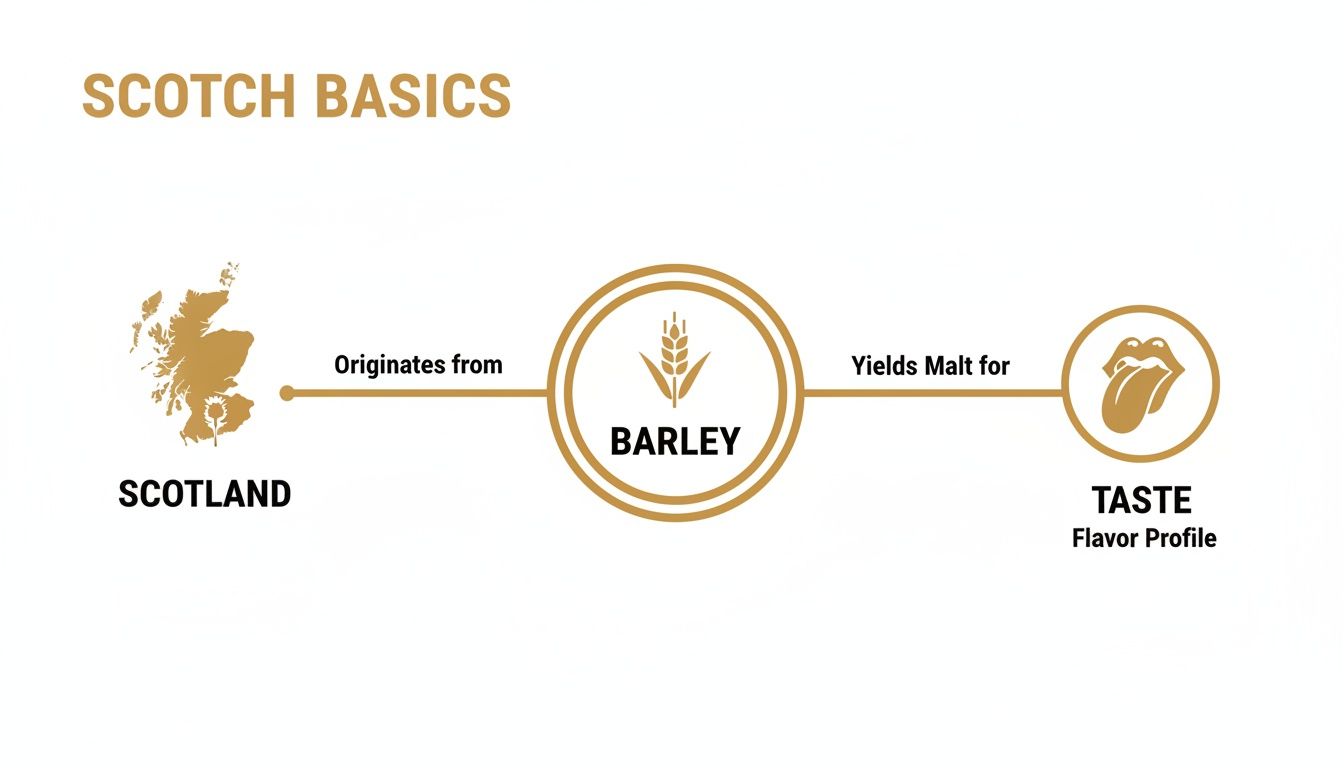
As you can see, the fundamental building blocks—the local terroir, the grain, and the distillation process—are what create the incredible diversity you're about to discover.
Speyside: The Orchard of Scotland
Speyside is the beating heart of the Scotch world, home to over half of Scotland's distilleries. If you generally lean towards lighter, sweeter drinks, this is your perfect starting point. Think of Speyside whiskies as the crisp, fruity white wines of the Scotch universe.
These drams are known for their elegant and approachable profiles. You’ll often find notes of green apple, juicy pear, honey, and vanilla. Many distilleries here use ex-sherry casks for maturation, which adds wonderful layers of sweet fruit jam and warm baking spices. It’s a gentle, welcoming handshake into the world of single malts.
Highlands: The Diverse Mountain Range
The Highlands cover a huge geographical area, and as you might expect, they produce an incredible variety of styles. There really is no single "Highland" character, which makes exploring this region a true adventure. You can find everything from light and floral drams to rich, powerful, and subtly smoky spirits.
A whisky from the northern Highlands, for instance, might have a complex, slightly salty character, while one from the south could be much softer and fruitier. This is a key lesson for anyone new to whisky: never assume all whiskies from one region taste the same. It's a land of contrasts with something for nearly every palate.
Think of the Scotch regions not as rigid rules but as helpful signposts. They guide your expectations and help you navigate the vast landscape of flavors, making it easier to find a style you’ll love.
Lowlands: The Gentle and Grassy Fields
Known for producing some of the softest and most delicate whiskies in Scotland, the Lowlands are all about approachability. Historically, many Lowland distilleries triple-distilled their spirit, a practice that results in a lighter, smoother character that’s incredibly easy to drink.
Expect flavors that are gentle, grassy, and floral with a creamy sweetness. These whiskies are almost always unpeated, making them a fantastic choice for anyone who isn't quite ready for smoke. Their mellow nature makes them perfect for sipping neat on a warm day or using as the base for a top-notch highball.
Islay: The Smoky Campfire Coast
Welcome to the home of the "peat monsters." Islay (pronounced 'eye-lah') is world-famous for its powerful, smoky, and distinctly maritime whiskies. That signature flavor comes from peat, which is essentially decomposed vegetation that’s burned to dry the malted barley, infusing it with an intense smoky character.
The result is a bold spirit loaded with notes of campfire smoke, iodine, seaweed, and sea salt. While that might sound intimidating, an army of whisky lovers finds it deeply rewarding. If you enjoy smoky BBQ, a good cigar, or even some of the mesquite-smoked American single malts from craft brands like Westland Distillery, you might just find your new favorite dram here. To really get a handle on this unique flavor, check out our guide explaining what is peaty Scotch and why it's so beloved.
Campbeltown: The Coastal Enigma
Once a bustling whisky capital with over 30 distilleries, Campbeltown is now Scotland's smallest whisky region, with just a few producers left. But what it lacks in quantity, it more than makes up for in character. Campbeltown whiskies are legendary for their unique complexity.
Here, you can expect a fascinating combination of briny sea salt, subtle smoke, and rich fruity notes, all coming together in a wonderfully funky and robust profile. It’s a historic region that offers a taste of Scotch history in every single sip.
A Beginner's Guide to Scotch Whisky Regions
To pull it all together, this table gives you a quick snapshot of what to expect from each region and a solid, accessible bottle to get you started.
| Region | Common Flavor Profile | Beginner-Friendly Example |
|---|---|---|
| Speyside | Fruity, sweet, and elegant notes like apple, honey, and vanilla. Often unpeated. | The Glenlivet 12 |
| Highlands | Diverse; can range from light and floral to rich and robust, sometimes with a hint of smoke. | Glenmorangie The Original 10 |
| Lowlands | Soft, light, and gentle with grassy, floral, and creamy characteristics. | Auchentoshan American Oak |
| Islay | Bold, powerfully smoky, and maritime with notes of peat, brine, and iodine. | Lagavulin 8 Year |
| Campbeltown | Complex and briny with a mix of fruit, subtle smoke, and a distinct salty character. | Glen Scotia Double Cask |
Use this as your starting compass. Grab a bottle from a region that sounds appealing and see where the journey takes you
How to Taste Scotch and Unlock Its Secrets
Tasting Scotch isn't a test. There are no right or wrong answers, just your own experience. It’s an opportunity to slow down and appreciate what's in your glass.
For anyone new to Scotch, especially if you're coming from the world of American craft whiskey, having a simple, structured approach can make all the difference. It helps you move beyond just "drinking" and into really understanding the spirit. Think of it as a guided tour for your senses, turning a simple dram into a fascinating activity.
This five-step method isn’t a rigid rulebook. It’s just a way to coax out the secrets a whisky holds—secrets that distillers have spent years, sometimes decades, perfecting.
Step 1 The Look
Before you even think about taking a sip, hold your glass up to the light. The color alone can tell you a story. A pale straw hue might hint that it was aged in ex-bourbon barrels, while a deep amber or ruby color often points toward maturation in ex-sherry casks.
Gently tilt the glass and give it a swirl, watching the liquid coat the sides. You'll see streaks, known as "legs" or "tears," running back down. If the legs are thick and slow-moving, it can indicate a higher alcohol content or a more viscous, oily texture—a clue to a richer mouthfeel to come.
Step 2 The Nose
This is a huge part of the experience. Your sense of smell accounts for the vast majority of what we perceive as flavor, so don't rush this step.
Bring the glass toward your nose, but keep your mouth slightly open as you inhale gently. This simple trick prevents the alcohol vapor from overwhelming your senses and lets the aromas shine through. Don't swirl it aggressively like wine; that just releases too much alcohol. Instead, gently move the glass from side to side or alternate nostrils.
Take your time. What do you smell? Is it fruity, like crisp apples or bright citrus? Sweet, like vanilla and honey? Or is there something smoky, like a distant campfire?
Pro Tip: Your first impression is often the most revealing. Don't overthink it. If you immediately think of something specific, like fresh-cut grass or grandma's apple pie, lock that in before your brain starts second-guessing.
Step 3 The Palate
Alright, the moment you've been waiting for. Take a small sip—just enough to coat your entire mouth. Let the whisky rest on your tongue for a few seconds. This first sip is mostly just to get your palate acclimated to the alcohol, so it might seem a bit sharp.
Now, for the second sip. Try to "chew" the whisky, rolling it around your mouth to make sure it hits all your taste buds. This is where you connect the dots between the aromas you smelled and the flavors you're tasting. Pay attention to the mouthfeel—is it thin and light, or is it rich, oily, and creamy? Try to pinpoint specific tastes. Is the sweetness like caramel, or more like dried figs? Is there a spicy kick of cinnamon or black pepper?
Step 4 The Finish
The finish is everything that happens after you swallow. It’s the lingering taste and sensation left in your mouth—the final chapter of the whisky's story and a huge indicator of its quality and complexity.
Ask yourself a few questions:
- How long does it last? A short finish disappears almost immediately, but a long, memorable one can evolve for minutes.
- What flavors stick around? Do the sweet notes from the palate linger, or do new smoky, spicy, or oaky flavors emerge?
- Is it warming? A pleasant, gentle warmth that spreads through your chest is a hallmark of a great spirit. Bourbon drinkers call it a "Kentucky hug," and the same satisfying sensation applies to a great Scotch.
The finish is often where a whisky reveals its deepest character. A truly well-made spirit leaves you with a long, pleasant impression that makes you want to go back for another sip. For a more detailed walkthrough, our comprehensive guide on the art of tasting Scotch whisky offers even more tips for beginners.
Step 5 Adding Water
Here’s a final trick that master blenders swear by: add a few drops of water. This isn’t about diluting the whisky; it’s about unlocking it.
Adding just a tiny bit of water can trigger a chemical reaction that "opens up" the spirit. It can soften the alcohol burn and release new, more subtle aromas and flavors that were previously hiding.
Use a straw or a pipette to add just one or two drops at a time. You'll often notice an immediate change on the nose and palate. It’s a powerful tool that can completely transform your tasting experience, making the whisky feel softer and more aromatic. For beginners, it’s an essential technique for appreciating the full spectrum of what a Scotch has to offer.
Single Malt vs Blended Scotch: What’s the Difference?
Walk into any liquor store, and one of the first things you'll notice on the Scotch aisle are the words "single malt" and "blended." It's one of the first hurdles every newcomer faces, but figuring out what they mean is simpler than you'd think. Getting a handle on this is the first real step toward finding the whiskies you'll love.
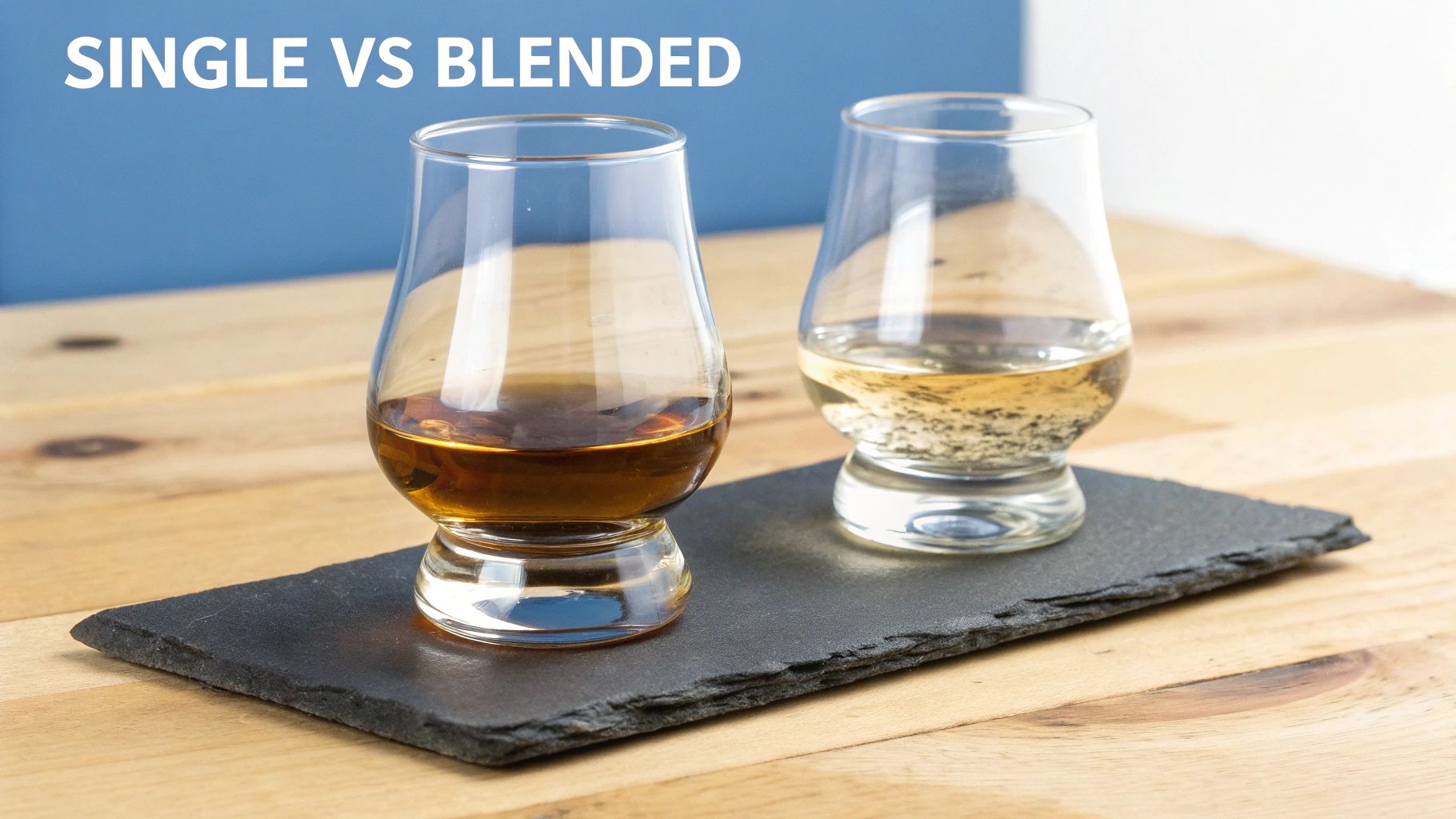
Here's an easy way to think about it: a single malt is like a solo artist. It’s a whisky made from 100% malted barley at just one single distillery. That means you're tasting the pure, unadulterated character of that specific place—its water, its equipment, and the philosophy of the people who made it.
A blended Scotch, on the other hand, is like a supergroup or an orchestra. A master blender carefully selects and combines whiskies from many different distilleries to create a final product that is balanced, consistent, and often more approachable. This is where the real art of blending comes into play.
Understanding Single Malt Scotch
A single malt is all about expressing a singular vision. Since every drop comes from one distillery, its flavor is a direct fingerprint of that distillery's unique style and the character of its home region.
This is exactly why a smoky, briny single malt from an Islay distillery tastes worlds apart from a delicate, fruity one made in Speyside. You’re tasting a specific dot on the Scotch flavor map. To really get into the weeds, you can explore the fundamentals of what makes a malt whiskey and see how that one grain defines the entire spirit.
Here's the simple checklist for a single malt:
- Made at a single distillery.
- Crafted from 100% malted barley.
- Distilled in traditional copper pot stills.
This tight focus on a single source is what gives these whiskies their distinct, and often wonderfully complex, personalities.
The Art of Blended Scotch
Believe it or not, blended Scotch is the most popular category of Scotch whisky on the planet, and for good reason. These whiskies are created by combining single malts (for character and complexity) with grain whiskies (which are made from other grains like corn or wheat and provide a smoother, lighter base).
The master blender’s job is an incredible skill. They have to pull from a massive library of whiskies—some old, some young, some peated, some sweet—and combine them perfectly to hit a specific, consistent flavor profile bottle after bottle, year after year.
Let's bust a common myth right now: 'single malt' does not automatically mean 'better' than 'blended.' That's just marketing talk. Many world-class blended Scotches offer unbelievable quality and complexity, often at a price that won't make your wallet cry.
Which One Is Right for You?
Honestly, there's no right or wrong answer here. It all comes down to what you're in the mood for.
- Choose a Single Malt if: You want to explore the unique character of a specific distillery or region. You're curious to taste a focused, singular flavor profile that tells a story of its origin.
- Choose a Blended Scotch if: You're looking for a smooth, balanced, and consistent experience. Blends are often fantastic, welcoming entry points for people just getting into Scotch.
For a lot of beginners, especially those coming from the American craft whiskey world, starting with a well-made blend is a great way to ease into the diverse landscape of Scotch. Brands like Johnnie Walker or the more craft-oriented Compass Box built their legendary reputations on creating exceptional blends.
Ultimately, the best approach is to try both. Forget the snobbery, appreciate each style for what it brings to the table, and let your palate—not the label—be your guide.
Common Mistakes New Whisky Drinkers Make
Every enthusiast's journey has a few early fumbles—it's just part of the process. But knowing the common pitfalls can help you sidestep them, making sure your first few drams are encouraging, not intimidating. Avoiding these simple errors will fast-track your confidence and open you up to the incredible diversity Scotch has to offer.
One of the biggest blunders is diving headfirst into a “peat monster.” Whiskies from Islay, like Laphroaig or Ardbeg, are legendary for a reason, but their intense, smoky, and medicinal notes can be an absolute shock to an uninitiated palate. It’s like trying the spiciest ghost pepper curry on the menu for your first-ever taste of Thai food—it’s usually better to work your way up.
Starting Too Strong or Too Specific
There's often this unspoken pressure for newcomers to start with a famous, and usually intensely flavored, single malt. This can quickly overwhelm your taste buds or, worse, lead you to believe all Scotch tastes like a campfire doused in iodine. A much smarter approach is to begin with more approachable, welcoming profiles.
Here are a few classic rookie moves and how to course-correct:
-
The Mistake: Immediately buying a heavily peated Islay Scotch.
-
The Fix: Start with a lighter, fruit-forward dram from Speyside or a soft, gentle whisky from the Lowlands. Expressions like Glenfiddich 12 or Auchentoshan American Oak are fantastic and accessible entry points.
-
The Mistake: Only focusing on single malts while dismissing blends.
-
The Fix: Don’t sleep on blended Scotch! High-quality blends like Johnnie Walker Black Label or Compass Box Artist Blend are expertly crafted for balance and smoothness, making them perfect for getting your bearings.
-
The Mistake: Splashing out on an expensive bottle you’ve never tried.
-
The Fix: Always try before you buy. Order a dram at a well-stocked bar, find a local tasting event, or grab a tasting kit. It’s the best way to discover what you genuinely enjoy without a major hit to your wallet.
Poor Tasting and Serving Habits
How you drink your Scotch is just as important as what you’re drinking. A few simple tweaks to your ritual can completely transform the experience. The whole point is to taste the spirit as the distiller intended, not to accidentally mask its character.
Remember, the best way to enjoy Scotch is ultimately the way you like it. But starting with these best practices lets you experience the full spectrum of flavor before you decide to add mixers or a pile of ice.
A very common misstep is using the wrong glass. Pouring a beautiful single malt into a shot glass or a wide-mouthed kitchen tumbler is a huge missed opportunity. A shot glass just encourages you to throw it back, while a standard rocks glass lets all those delicate, complex aromas escape into the air before they ever reach your nose.
Likewise, adding too much ice is a classic rookie move. While a single large cube can be a treat on a warm day, a glass packed with ice will rapidly chill and dilute the whisky. This numbs your palate and completely mutes the complex flavors the distillers worked so hard to create. Instead, always start by tasting it neat to get a baseline. From there, you can add a few drops of water to see how it "opens up" or a single large ice cube to chill it slowly. These small adjustments make a world of difference.
So, Where Do You Go From Here?
You’ve got the regions down, you can talk tasting notes, and you know how to sidestep the classic rookie mistakes. What’s the next turn on your Scotch journey? This is where the real fun begins: moving from reading about whisky to actively exploring it.
The best philosophy is simple: try before you buy. Committing to a full bottle can feel like a high-stakes gamble, both for your wallet and your palate. Luckily, there are much smarter, more affordable ways to figure out what you truly love. And remember, your adventure doesn't have to be a solo mission. The world of whisky is built on community and shared sips.
Smart Ways to Explore New Whiskies
Instead of dropping serious cash on a bottle you might not even like, you can sample a huge variety of spirits for a fraction of the cost. This is the fast track to developing your palate and ensures you only invest in the whiskies that really speak to you.
- Order a Whisky Flight: Any decent bar will offer tasting flights. These are small pours of three or four different whiskies, usually grouped by region or style. It’s the perfect, low-commitment way to compare a smoky Islay directly against a fruity Speyside right then and there.
- Hit Up a Local Tasting Event: Keep an eye out for events at your local liquor stores or dedicated whisky bars. These are fantastic chances to sample a wide range of spirits, often with a brand expert on hand to walk you through what you're tasting and answer your questions.
- Join a Tasting Club: Whether it’s a local group or an online community, a whisky club is a structured way to discover new drams with people who are just as curious as you are. It’s a great way to learn from others and share your own discoveries.
The Power of Tasting Blind
One of the single most effective ways to sharpen your palate is through blind tasting. This is exactly what it sounds like: you taste whiskies without knowing the distillery, the price tag, or the age statement. It strips away all the marketing hype and preconceived notions, leaving just you and the spirit in the glass.
By removing brand bias, blind tasting forces an honest conversation between you and the spirit. You might discover that your favorite dram of the night is an affordable blend, an obscure American craft whiskey, or an innovative release from Ireland—not the expensive single malt you thought you should like.
This is where a blind tasting subscription box can be an absolute game-changer, especially when you're just starting your scotch whisky for beginners journey. You get curated samples delivered right to your door, allowing you to explore the entire world of whisky from your own home. You might find a celebrated Scotch, a hidden gem from a small American craft distillery like Stranahan's or Balcones, or a complex Japanese whisky becomes your new favorite—all based purely on what’s in the glass.
As you explore, you're tapping into a massive global movement. The worldwide whiskey market is projected to swell from USD 77.92 billion to USD 116.01 billion by 2033. This explosion is being fueled by new drinkers from India to Europe, creating an incredibly dynamic scene where Scotch is just one player among amazing American and world whiskies. In this ever-expanding world of choice, letting your own taste lead the way is more important than ever. Discover more insights about these global whiskey trends and see how your personal journey fits into the bigger picture.
Your Scotch Questions, Answered
Jumping into the world of Scotch can feel like learning a new language, and it's natural to have a few questions. Getting some straightforward answers right from the start can make the whole journey a lot more fun and a lot less intimidating. Let's tackle some of the most common ones.
What Is the Best Scotch for a Beginner?
There's no single "best" bottle out there, simply because everyone's taste is different. That said, the most successful starting points are usually whiskies that are on the lighter, sweeter, and unpeated side of the spectrum. This lets your palate get acquainted with the spirit without being totally overwhelmed.
You'll generally have good luck looking for bottles from these regions:
- Speyside: Known for its elegant and fruity character. Think apple, pear, and honey notes.
- Lowlands: Famous for producing soft, gentle drams that are often floral or grassy.
Bottles like The Glenlivet 12, Glenfiddich 12, or Auchentoshan American Oak are fantastic entry points. They're classics for a reason—accessible, well-made, and perfect benchmarks for starting your exploration.
Does Age Matter in Scotch Whisky?
An age statement tells you one thing and one thing only: the age of the youngest whisky in that bottle. While it's an indicator of maturity, it's not an automatic guarantee of quality. Older whiskies often gain smoothness and complexity from their time in the cask, but they can also become heavily oak-influenced, a flavor that doesn't appeal to everyone.
You'll also find plenty of incredible "No Age Statement" (NAS) whiskies on the shelf. With NAS bottles, the master blender isn't tied to a minimum age; their goal is to hit a specific flavor profile. This gives them the flexibility to blend various whiskies to create something truly unique. Don't let a big number on the label be your only guide.
A simple rule of thumb for newcomers: focus on the flavor profile first and the age statement second. An 8-year-old Scotch you genuinely enjoy is infinitely better than a 21-year-old you don't.
What Is Peat and Why Do Some Scotches Taste Smoky?
Peat is essentially decomposed plant matter, dug up from bogs and historically used as a primary fuel source across Scotland. In whisky making, some distilleries dry their malted barley over a smoldering peat fire. The smoke from this fire infuses the barley with compounds called phenols, which are responsible for those iconic smoky, medicinal, or earthy flavors.
The island of Islay is world-famous for its powerful, heavily peated Scotch. If you've ever enjoyed the smoky character of some American craft whiskeys, you might find peated Scotch to be a fascinating next step. Just know that it's a bold flavor, so it's best to approach it with an open mind and a curious palate.
How Should I Store My Bottle of Scotch?
Unlike wine, Scotch doesn't continue to age once it's bottled. To keep it tasting the way the distiller intended, proper storage is key. The rules are simple: always store your bottles upright in a cool, dark place, well away from direct sunlight.
Storing it upright is the most important part. The high-proof alcohol can eat away at the cork over time if the bottle is on its side, potentially tainting the whisky. An opened bottle, if sealed tightly and stored correctly, can last for years, though you might notice its flavors soften just a bit over many months from slow, gradual oxidation.
Ready to discover your next favorite whisky without the guesswork? At Blind Barrels, we send you curated blind tasting kits featuring top-shelf American craft whiskies, so your palate can be the judge. Explore our whiskey tasting subscriptions and let your taste buds lead the way.