

American whiskey encompasses eight federally recognized legal categories, not just the three most people know, and American whiskey sales reached $5.1 billion in 2023, which is one reason the category keeps showing up on more shelves and in more tasting kits. That matters because the bottle in your hand might be bourbon, rye, Tennessee whiskey, or one of several less familiar styles that look similar at a glance but taste very different in a glass.
You might be standing in front of a shelf right now, reaching for the label you already recognize. That's exactly where most drinkers start, and it's also where a lot of confusion begins, because American whiskey isn't one personality, it's a whole family.
A good way to think about it is like looking at a band where everyone plays the same basic instruments, but each member has a different role. Corn brings sweetness, rye brings snap, wheat softens things, malt adds a grainy depth, and oak shapes the finish. Once you know that, the category stops feeling random.
If you like browsing a broad spirit selection before a tasting night, the Pep Tea liquor collection is a useful place to compare styles side by side and train your eye for labels that mean something.
Why You Probably Only Know Three Types of American Whiskey
You've probably held a bourbon bottle, maybe picked up a rye, and seen Tennessee whiskey sitting nearby like a familiar cousin. Most drinkers stop there because those three dominate the conversation, the shelf space, and the bartender's shorthand. But that's only the front row of the family photo.
At a blind tasting table, that gap shows up fast. A glass lands in front of you with no label, no brand story, and no price tag to anchor your guess. All you get are aroma, palate, and finish, which is exactly why the broader types of American whiskey matter so much.
The shelf tells a smaller story than the law
The legal category system is wider than most beginner guides let on. American whiskey is divided into eight federally recognized styles, built around grain composition, proof limits, and barrel rules, not vague marketing language. That means you're not just learning names, you're learning a pattern you can taste.
The usual beginner mistake is treating bourbon, rye, and Tennessee whiskey as if they're the whole map. They're not. Once you add wheat, malt, corn, light, and blended whiskey, the category starts to feel less like a shortlist and more like a toolkit.
Practical rule: if you can identify the grain before you identify the brand, you're already tasting like a better whiskey drinker.
For a bottle-by-bottle browsing habit, that shift is huge. A guide to the Blind Barrels whiskey approach makes more sense once you realize the point isn't memorizing labels, it's learning to recognize style from the glass itself. The same logic applies whether you're shopping for a favorite bottle or building confidence at a tasting table.
The Federal Framework Behind Every American Whiskey Type
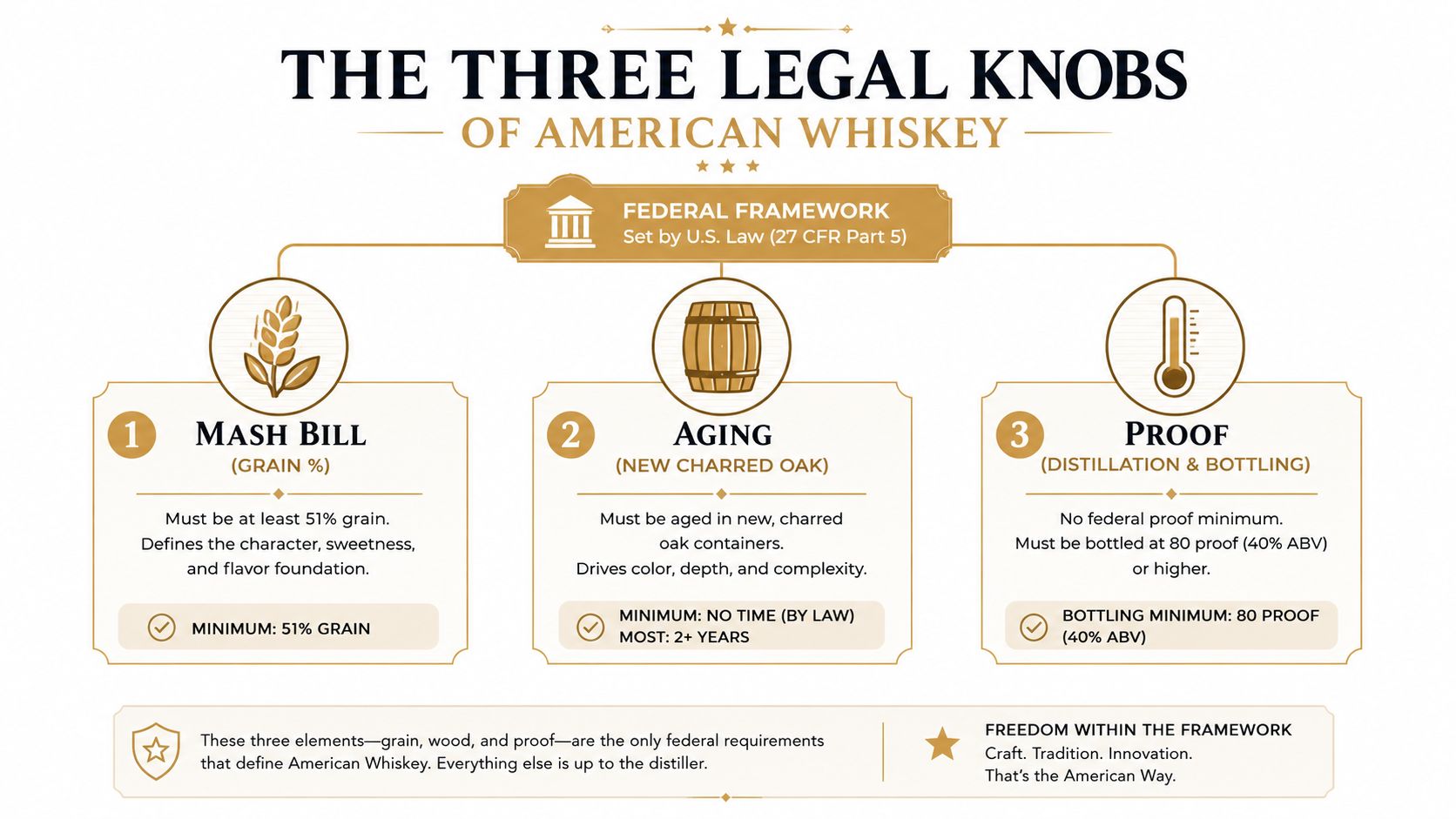
The easiest way to understand American whiskey is to stop starting with brand names and start with the rules. Three legal controls do most of the work: mash bill, distillation proof, and barrel entry and aging rules. Once those pieces are clear, the category stops feeling scattered and starts feeling readable.
The mash bill sets the flavor path
Mash bill is the grain recipe, and it is the first place the style shows up. Corn pushes sweetness, rye pushes spice, wheat softens the edges, and malted barley adds a nutty, cereal-like depth. If you know which grain is doing the heavy lifting, you already have a solid preview of how the whiskey will taste.
That is why the named categories exist at all. Bourbon needs at least 51% corn, rye whiskey needs at least 51% rye, wheat whiskey needs at least 51% wheat, malt whiskey needs at least 51% malted barley, and corn whiskey needs at least 80% corn. Those thresholds are not trivia, they are the federal clues that shape the glass.
Proof controls how much grain character stays in the spirit
The second control is distillation strength. For the major traditional types, the spirit cannot come off the still above 80% ABV. That ceiling matters because a higher proof strips away more grain character, while a lower proof leaves more of it behind. The still is doing quiet work here, deciding how much of the grain's personality survives to the barrel.
Oak is where the style gets polished
The barrel rule is the third control, and bourbon is the clearest example. Bourbon has to go into new charred oak at no more than 62.5% ABV. Fresh oak acts like a flavor filter and a seasoning layer at the same time, bringing the vanilla, caramel, and spice notes people often associate with American whiskey.
Tennessee whiskey follows a similar base structure, but it adds its own charcoal filtering tradition. Light whiskey and blended whiskey move in different directions, which is why the full family is broader than the big three many hear about first. If you want a simple tasting shortcut, a guide to the Blind Barrels whiskey approach makes the same point from another angle, style recognition starts with what the glass gives you, not with the label.
Bourbon Rules and Why Corn Creates Its Signature Sweetness
Bourbon is the style most commonly associated with American whiskey, and that's no accident. It's the category built to show how grain and new oak work together. If you've ever tasted vanilla, caramel, and a warm grain sweetness in the same sip, bourbon is probably the benchmark you were using.
Corn gives bourbon its shape
By law, bourbon has to start with a mash bill of at least 51% corn, and that matters because corn reads as sweet on the palate. It doesn't make the whiskey sugary, but it does set up that rounded, friendly first impression that so many drinkers notice right away. Corn is the reason bourbon tends to feel welcoming even when the proof is firm.
The second legal piece is the distillation cap at 80% ABV. That ceiling helps preserve more grain character than a more aggressive distillation would, which is why bourbon can still taste like grain instead of disappearing into a neutral base. You're not just drinking oak and alcohol, you're tasting the raw ingredients that survived the still.
New charred oak does the finishing work
The third rule is the barrel. Bourbon must enter new charred oak at no more than 62.5% ABV, and that fresh wood is where the familiar flavor profile really locks in. New oak contributes the vanilla, caramel, and spice notes people associate with the category, while the char layers in a toasty edge.
A small craft example makes this easier to picture. A Blind Barrels kit often includes bottles from American craft distilleries that use different mash bills and barrel choices to shape distinct flavors, so one bourbon may read sweeter and creamier while another lands spicier and drier. The label tells you only the name, but the glass tells you how the recipe was built.
Look for a sweet grain note up front, a rounded middle, and a warm oak finish. That sequence is one of the easiest ways to spot bourbon in a blind pour.
If you want to study the grain side more closely, the bourbon grain bill guide is a practical reference point. It helps turn the legal minimums into tasting habits you can use at home.
Rye, Wheat, and Malt Whiskey The Grain That Defines the Style
Once you move past bourbon, grain choice starts doing even more of the heavy lifting. Rye, wheat, and malt whiskey can share the same general American whiskey family tree, but they taste like different conversations. One leans sharp, one leans soft, and one leans heavily cereal-driven.
Rye brings the bite
Rye whiskey has to be made from at least 51% rye, and that grain usually shows up as pepper, baking spice, and a drier finish. It's the bottle you reach for when you want the whiskey to cut through rich food or stand up in a cocktail. A bold rye doesn't hide, it speaks first.
Wheat and malt change the texture
Wheat whiskey requires at least 51% wheat, and that often translates to a softer, breadier sweetness. It can feel gentler than bourbon, with less obvious spice and a smoother mid-palate. Malt whiskey, at 51% malted barley, moves in a more toasted, cereal-like direction that can feel familiar to people who enjoy single malt traditions.
| Style | Mash bill threshold | Common tasting impression | Easy food pairing |
|---|---|---|---|
| Rye whiskey | 51% rye | Spicy, dry, sharp | Smoked meats |
| Wheat whiskey | 51% wheat | Soft, bready, round | Roasted poultry |
| Malt whiskey | 51% malted barley | Toasted, grainy, nutty | Aged cheese |
The easiest blind-tasting trick is to focus on the middle of the palate. Rye usually pushes spice across the tongue, wheat tends to feel cushioned, and malt often comes across as dry cereal or biscuit. That grain signal matters more than the label, especially in small-batch bottles where oak can't completely flatten the base recipe.
For a helpful contrast between the two most commonly confused grain styles, the wheat whiskey vs rye guide is worth a look. It's the kind of side-by-side comparison that sharpens your palate faster than reading flavor adjectives in isolation.
Tennessee Whiskey and the Charcoal Filtering Tradition
Tennessee whiskey sits close enough to bourbon that people often blur the two together, but there's a meaningful difference. The defining feature is the Lincoln County Process, where the spirit is filtered through sugar-maple charcoal before maturation. That step changes the texture before the whiskey ever sees the barrel.
The charcoal step changes the feel
Charcoal filtering doesn't make the whiskey a different species, but it does make it feel different in the glass. The process tends to strip away some harsh edges and leaves a softer entry on the tongue. If bourbon often announces itself with a little more grip, Tennessee whiskey usually arrives with a smoother handshake.
That's why geography alone doesn't define the style. Being made in Tennessee matters, but the charcoal mellowing tradition is what gives the category its identity. The result is often a rounder, gentler spirit that still carries grain and oak character, just with fewer rough corners.
Why tasters notice it so quickly
At a blind tasting, the difference often shows up as mouthfeel before anything else. Tennessee whiskey can feel more polished at the start and a little mellower on the finish, especially next to a bourbon with a similar age or proof. That's useful because you don't need to guess the exact recipe, you just need to notice the texture.
Practical rule: if the whiskey feels softer at entry and less angular at the end, Tennessee whiskey should be on your shortlist.
Some small producers keep the process traditional, while others experiment around the edges, but the charcoal tradition remains the clearest marker. A strong blind guess starts with that softness, then checks whether the grain and oak support it. If they do, you're probably not far off.
Corn, Light, and Blended Whiskey The Forgotten Categories
The overlooked corners of the American whiskey family matter because they explain what the category is doing outside the premium shelf. Corn whiskey, light whiskey, and blended whiskey each answer a different need, and none of them are accidental leftovers. They're functional styles with their own place in the system.
Corn whiskey keeps the grain loud
Corn whiskey must be at least 80% corn, which makes it the most corn-forward of the familiar legal categories. It's often unaged or aged in used oak, so the grain stays front and center. That means a rawer, more direct profile, with less barrel polish than bourbon.
Light whiskey and blended whiskey solve different problems
Light whiskey is distilled above 80% ABV and aged in used or uncharred oak, which gives it a much milder character. It exists for drinkers who want a lighter spirit base, especially in mixed drinks. Blended whiskey can include straight whiskeys along with light whiskey or neutral spirits, which makes it a tool for consistency and accessibility.
Why they belong in the conversation
These styles matter because they round out the category. Corn whiskey preserves an older grain-heavy tradition, light whiskey serves a softer commercial profile, and blended whiskey gives producers another way to build a consistent bottle. Serious tasting gets better when you stop treating them like footnotes.
A lot of guides skip these bottles entirely, but that's where the family tree gets interesting. The big names are easier to remember, yet the lesser-covered categories show how broad the American whiskey world really is. If you want the full map, you need these corners too.
Blind-Tasting American Whiskey Like a Pro at Home
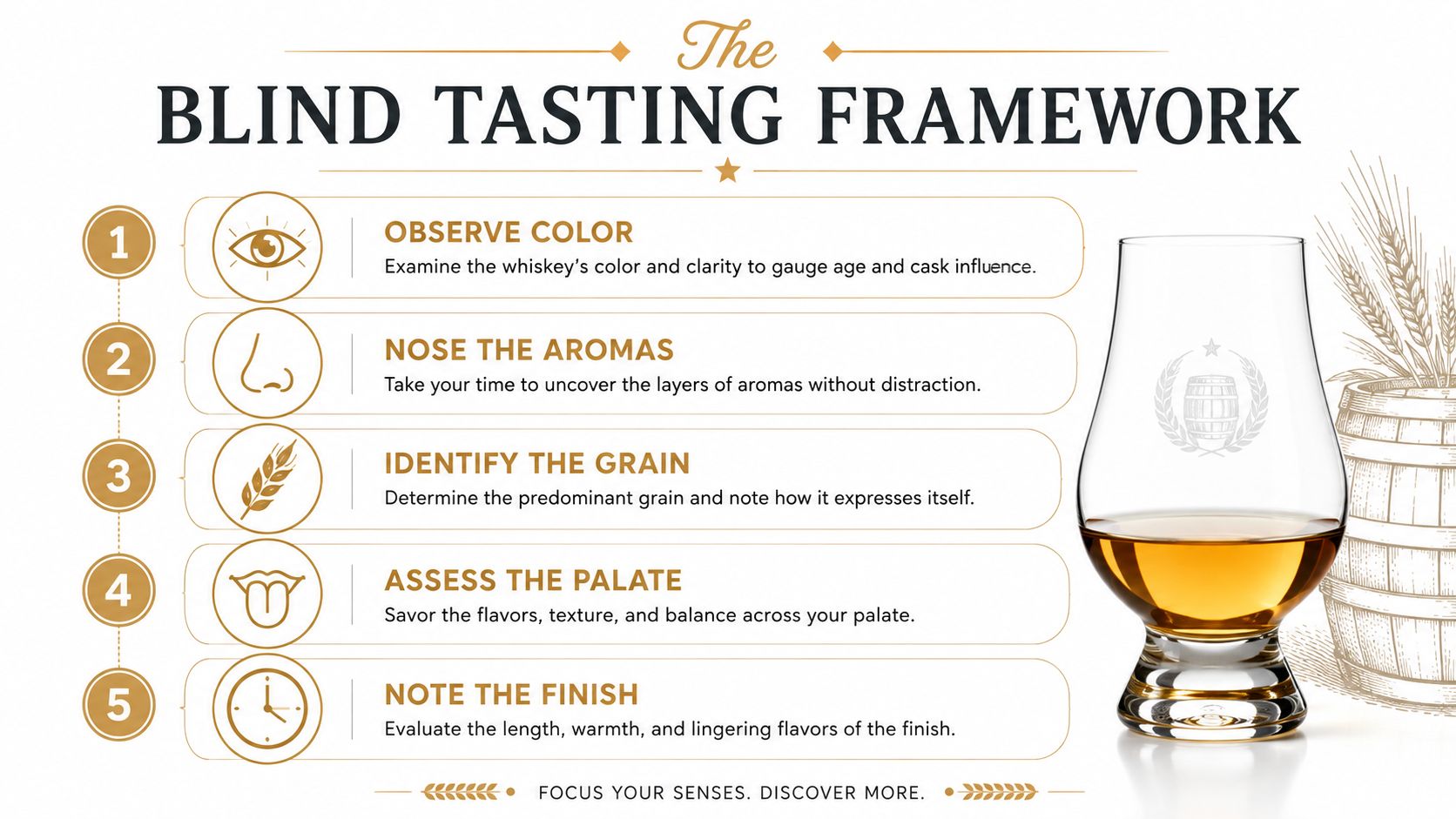
Blind tasting turns knowledge into skill because it forces you to trust your senses instead of the label. That's especially useful with American whiskey, where grain, proof, and oak each leave a clear fingerprint. A good tasting method keeps you from chasing brand reputation and helps you focus on what's in the glass.
Start with aroma, then move to palate
First, smell the glass without rushing it. Bourbon usually gives off a sweeter grain-and-oak combination, rye tends to carry a sharper spice note, and wheat can feel softer and more bready. Malt whiskey often smells toastier and more cereal-like.
Next, taste for where the whiskey hits. Rye often shows its spice in the middle of the tongue, wheat feels smoother and less aggressive, and bourbon usually balances sweet grain with oak and caramel. Light whiskey can feel cleaner and less grain-heavy, while corn whiskey often lands direct and grain-forward.
Finish is the final clue
The end of the sip matters as much as the first impression. A bourbon finish often stays warm and oaky, rye can leave a dry peppery echo, and Tennessee whiskey may feel smoother and more mellow as it fades. That final note is where your first guess gets confirmed or corrected.
A simple scorecard helps too. If you're using a tasting kit from a service like Blind Barrels, track three things for each pour, age estimate, proof estimate, and whiskey type. Then write one note for aroma, one for palate, and one for finish.
If you like testing your palate across categories, pairing a whiskey session with something equally style-driven, like the top Belgian beer picks Manchester guide, can sharpen your sense of sweetness, spice, and texture by comparison. Different drinks, same habit, pay attention to what the glass is doing.
Your Next Pour Putting the Types to Work
The easiest way to use this knowledge is to taste in sequence, not at random. Start with bourbon and Tennessee whiskey to build a sweet, oak-forward baseline, the kind of profile that helps your palate recognize familiar grain and barrel notes before the more unusual categories show up.
After that, move to rye and wheat so you can feel how spice and softness pull the same American framework in different directions. Then try corn, malt, light, and blended whiskey. Those bottles fill in the edges of the category and make the full family easier to understand. Once you have tasted them side by side, the legal language stops feeling abstract and starts sounding like a set of practical clues.
Blind tasting makes this even more useful because it removes the label from the equation. You stop asking, “What is this bottle supposed to be?” and start asking, “What do the grain, proof, and oak tell me?” That is the skill that turns a casual sip into a repeatable tasting practice.
A structured tasting kit from a service like Blind Barrels gives you a simple way to practice that approach with blind pours from small American craft distilleries, so you can compare styles without leaning on brand bias. It is a straightforward way to turn the types of American whiskey into something you can identify by taste alone.
If you are ready to put the categories into practice, visit Blind Barrels and try a blind tasting that lets you compare American whiskey styles without seeing the label first. It is a practical way to sharpen your palate, learn the difference between grain-driven profiles, and make every pour feel more intentional.