

Many believe smooth whiskey comes from a big price tag or a long age statement. That shortcut sounds tidy, but it misses how whiskey behaves in the glass. A bottle can be young and soft, old and sharp, expensive and still hot on the finish.
What makes whiskey smooth is usually a mix of proof, distillation, maturation, and the way those choices change what your nose and palate experience. Alcohol heat matters because whiskey in the United States must be distilled below 95% ABV and bottled at no less than 40% ABV (80 proof), so there's plenty of room for difference even inside legal bottling rules. Independent whiskey coverage also notes that 80 proof/40% ABV can feel lighter and smoother, while higher proof tends to feel hotter on the palate, especially because harshness can climb sharply in the 32%–48% ABV range Green River Whiskey.
Smoothness is also personal. One drinker reads vanilla and oak as soft and rounded, another focuses on pepper, heat, or dryness. The smartest way to judge it is to taste with your own senses, not the label's promises.
Why Age and Price Do Not Guarantee Smoothness
A long age statement can be impressive, and a high price can catch the eye, but neither one promises a smoother pour. Whiskey can rest in oak for years and still drink sharp if the distillation cut left too much edge, if the barrel pushed the spirit too hard, or if the blender chose structure over softness. Smoothness is best treated as a perception, shaped by how the whiskey was made and how your palate reads it.
A younger whiskey can feel easier to drink because the distiller started with a cleaner spirit. One technical explanation links smoothness to a lower congener load and a tighter heads and tails cut, which leaves fewer harsh compounds in the glass The Whiskey Wash. To put it plainly, careful distillation can trim away rough edges before the whiskey ever sees a barrel, so age does not have to do all the work.
Label clues that help, but don't decide everything
An age statement tells you how long the whiskey spent in wood, not how it was cut, blended, or bottled. Price can reflect rarity, packaging, or brand positioning just as much as flavor. A well-made craft bourbon or rye from an American distillery can feel gentler than a more expensive bottle if the proof is lower and the spirit was handled with care.
Practical rule: if a whiskey is marketed as smooth, check the proof first, then look for clues about maturation and distillation style.
A tasting flight is more honest than shopping by prestige. Set two glasses side by side, one younger and one older, and the bottle that smells calmer and finishes cleaner may owe more to production choices than to time in oak. American craft distilleries show this clearly, because smaller producers often make different style decisions from batch to batch.
The Chemistry Behind Ethanol Burn and Congeners
The burn in whiskey starts with ethanol, not with age, prestige, or the color in the glass. Ethanol is the main reason many drinkers feel heat, and that sensation grows as proof rises. Perceived harshness can also climb sharply in the 32%–48% ABV range, which is one reason a small proof change can feel bigger than the label suggests Green River Whiskey.
That is why a bottle at 40% ABV can seem easygoing while a higher-proof expression turns hot quickly. Coverage from Ezra Brooks also notes that 80 proof (40% ABV) often drinks lighter, and that higher ABV generally increases the burn sensation Ezra Brooks.
What congeners do in the glass
Congeners are the flavor compounds that carry over during fermentation and distillation. Some add depth and aroma, while others bring roughness if too much of the wrong material remains. That is why distillers pay close attention to heads and tails cuts, the points where they decide what stays in the spirit and what gets removed.
Those cuts work like trimming the crust from a sandwich. Leave too much crust, and the bite feels coarse. Trim carefully, and the center stays flavorful without the rough edges.
A cleaner distillation can preserve pleasant aroma-active fractions while reducing harsh compounds, which is one reason smoother whiskeys often come from careful production rather than age alone The Whiskey Wash. The same distillery can release one whiskey that drinks soft and another that feels assertive, even when the grains are similar. Cut points, proof, and the amount of congeners left in the spirit all change the result.
The main idea is simple. If ethanol is the heat, congeners shape the texture around that heat. Smooth whiskey usually feels balanced because neither one takes over the glass.
How Oak Barrels Transform Harsh Spirit Into Smooth Whiskey
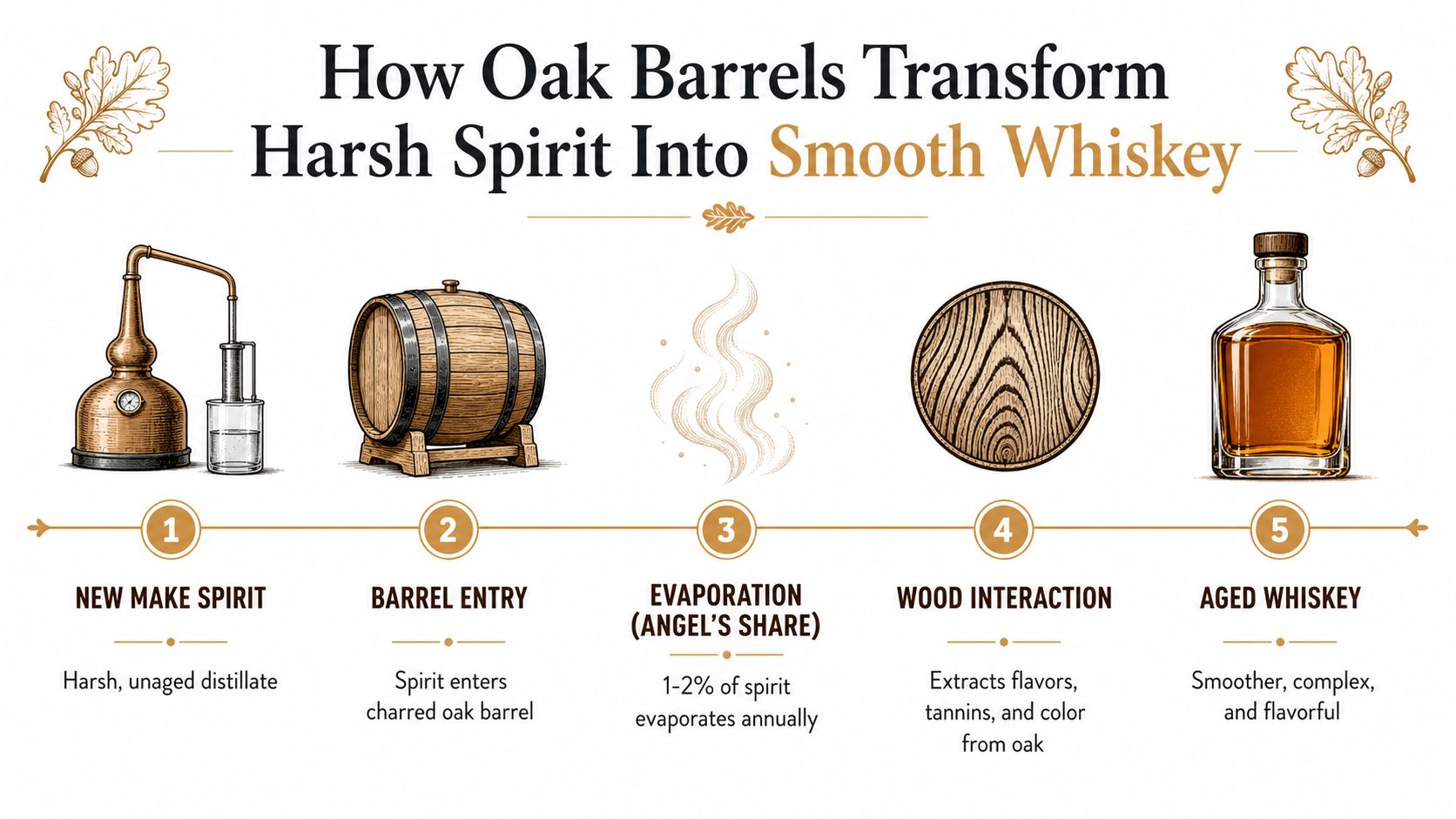
Fresh spirit usually tastes raw before oak gets a say in the final result. Inside the barrel, the whiskey changes through evaporation, oxidation, and extraction, and each of those processes nudges the spirit away from rough edges and toward a rounder mouthfeel. A practical explanation from Alibaba product insights notes that barrels can lose part of their contents each year to the Angel's Share, while the liquid pulls in wood-derived compounds that soften the finish and deepen flavor.
Oak does several jobs at once. It contributes sugars, vanillins, and lactones, while also letting sharper volatile notes fade with time. That is why experienced tasters often describe maturation as the period when a whiskey loses its sharp corners and starts to feel more centered in the mouth.
Why older can feel smoother, but only to a point
Aging can make whiskey feel smoother because the barrel keeps changing the spirit, but time alone does not guarantee a softer pour. The same Alibaba explanation says the most noticeable smoothing often happens in the early years, with refinement continuing later and diminishing returns after a long rest in wood Alibaba product insights. That helps explain why some older bottles taste polished while others start to lean woody or dry, even if the age statement sounds impressive.
American craft distilleries make this easier to see in practice. A barrel stored high in a warm warehouse can mature differently from one kept lower and cooler, because heat, airflow, and evaporation all shape how fast the spirit interacts with the wood. Two whiskeys with the same grain bill and the same age can still taste different if they spent their years in different parts of the rickhouse.
For a practical look at how oak changes whiskey over time, see Blind Barrels' oak barrel aging guide. The main point is simple, smoothness comes from chemistry, not just the calendar. Age can help, but only because oak, oxygen, and evaporation are actively reshaping the spirit in the barrel.
Proof and Distillation Methods That Shape Mouthfeel
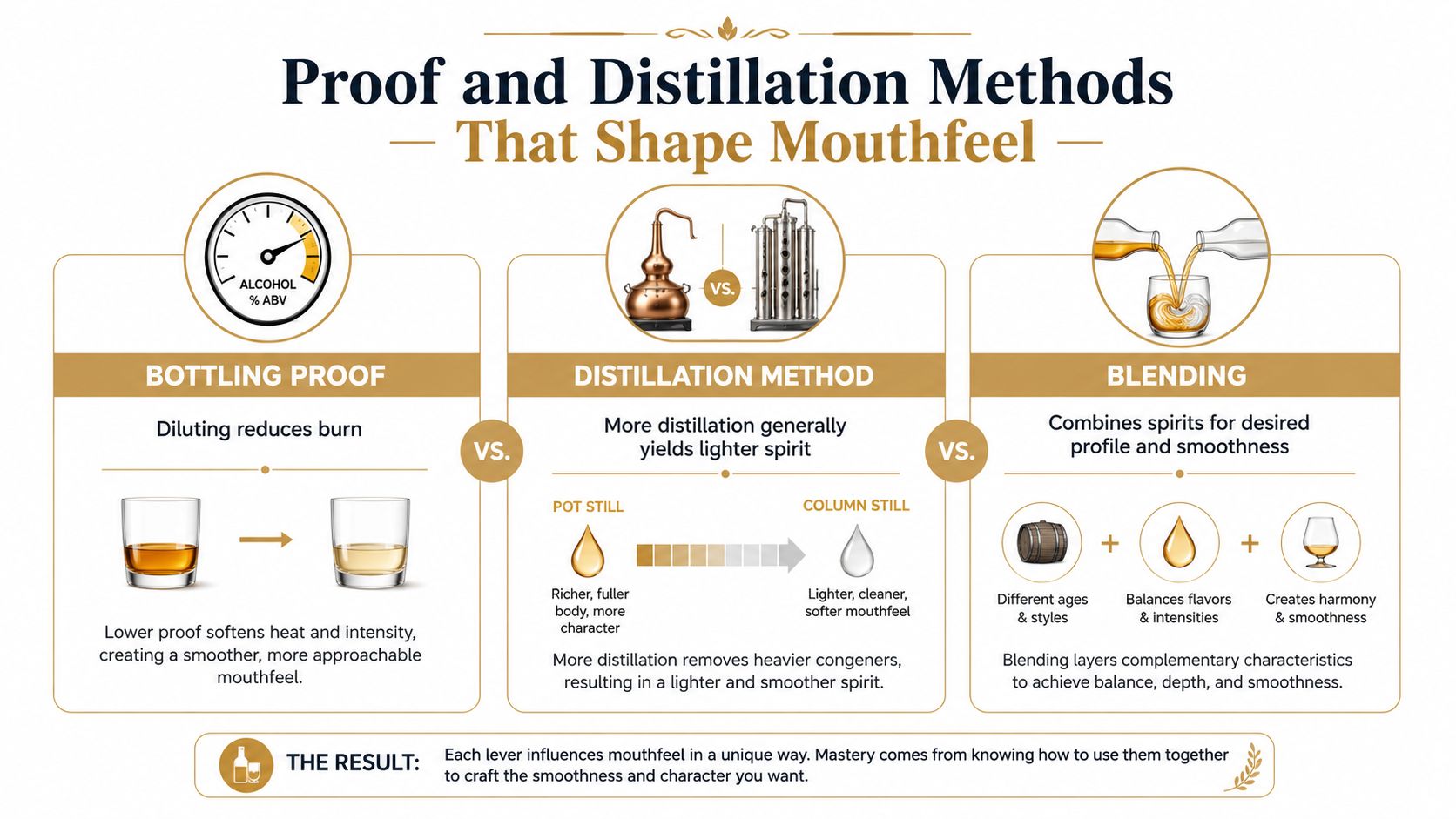
Three levers shape mouthfeel in a noticeable way, bottling proof, distillation method, and blending. Proof is the easiest to feel right away. A whiskey bottled at a lower proof usually feels calmer because there is less alcohol concentration pressing against the palate, and U.S. whiskey must be bottled at no less than 40% ABV (80 proof).
That is one reason many approachable American whiskeys sit close to the legal minimum. They still taste like whiskey, but they give flavor more room before heat takes over. Higher proof can be exciting for experienced drinkers, though it often reads as more forceful than smooth.
Distillation style changes the feel before the bottle is filled
The still matters before the whiskey ever reaches a barrel. A spirit run through more distillation usually comes out lighter, cleaner, and less likely to carry rough edges. For readers comparing styles, a useful reference point is pot still versus column still.
Jameson's guide says “Triple-distilled Irish whiskeys are known for their smooth characteristics” and defines smooth-drinking whiskey as something that goes down easily without a harsh bite Jameson. That fits the basic chemistry of distillation. Each pass through the still can leave behind some heavier compounds, so the finished spirit may feel less aggressive on the tongue.
More distillation does not automatically make whiskey better. It usually makes the spirit lighter, cleaner, and less forceful on the palate.
American craft distillers use both pot stills and column stills, and the choice changes the texture in the glass. A pot still can preserve more grain character, while a column still often produces a lighter spirit that many drinkers read as softer. Neither path is right for every whiskey, because the distiller is deciding how much body to keep and how much sharpness to carry forward.
Blending gives the blender room to tune softness
Blending is the final adjustment. A blender can combine barrels of different ages, proofs, or flavor personalities to build a consistent profile that a single cask could not deliver on its own. That is not a shortcut, it is careful shaping. The final whiskey can feel smoother because the blender has balanced oak, sweetness, and heat before bottling.
A good blender is working almost like a chef seasoning a soup at the end. One barrel may bring sweetness, another may add structure, and another may soften the edges enough to make the whole pour feel more even. This is also where a drinker should trust the palate, because a bottle that sounds impressive on paper can still feel hotter or rougher than a simpler whiskey poured side by side in a blind tasting.
A Simple Tasting Method to Assess Smoothness at Home
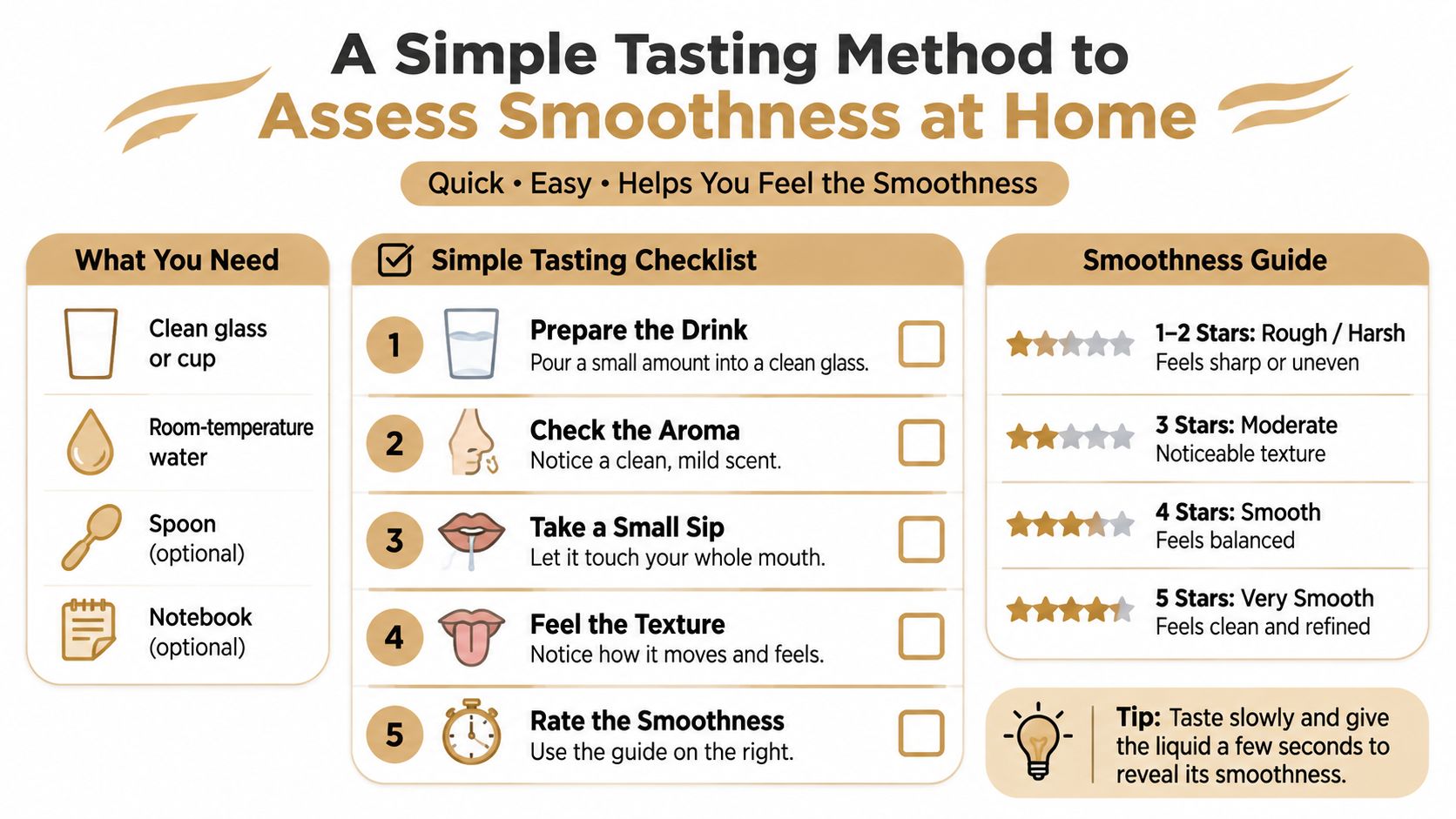
A good home tasting does not need fancy glassware or a large pour. It needs consistency. Pour a small measure into the same style of glass, give yourself a quiet space, and taste the whiskey in stages so your nose, tongue, and finish each get a fair look.
Start with the whiskey neat. Notice whether the first aroma feels sharp, sweet, woody, or faint. Then take a small sip and let it rest briefly before swallowing. Smoothness often shows up in the middle of the palate and in the tail end of the finish, not just in the first hit.
A blind side-by-side pour makes the comparison clearer.
Use identical glasses, keep the pours small, and taste one sample neat before adding water to another. A simple tasting guide from Blind Barrels' whiskey tasting method can help you set up the flight in a clean, repeatable way. If you want the most honest read on smoothness, blind the samples so the label does not steer your impression.
Use one drop of water, then wait
A single drop of water can change how a whiskey feels without changing the bottle itself. A sensory-study summary reports that tasters rated whiskies diluted to 46% ABV as “smoother,” “more balanced,” and “longer-finishing” than the same whiskies neat, even when they could not tell which sample had been diluted Alibaba product insights. Another guide recommends adding one drop of water, waiting 60–90 seconds, and tasting again side by side, because the water reduces ethanol's direct impact and gives the flavors room to settle Alibaba product insights.
Use that contrast on purpose.
- Observe the nose first: see whether the whiskey opens up or turns flatter after dilution.
- Track the palate next: pay attention to whether the burn moves back and the sweetness becomes easier to find.
- Finish with the finish: a smoother whiskey usually leaves a cleaner, more integrated aftertaste rather than a hot fade.
If a whiskey feels too hot neat, the water-drop method is a fair test, not a shortcut. It helps you hear what the bottle is saying once the ethanol stops shouting.
Why Blind Tasting Reveals Your True Smoothness Preference
Brand names are persuasive. So are labels, age statements, and the expectation that expensive whiskey should feel refined. Blind tasting removes those cues, which means your brain can't talk your palate into liking a bottle for the wrong reasons.
That matters because smoothness is subjective. One person wants a silky entry and barely-there heat, another wants oak and spice with enough grip to stay interesting. Blind tasting makes those preferences visible fast, especially when you line up different styles without knowing what's in front of you.
A blind flight teaches you what your palate actually rewards
A good blind flight doesn't need to be complicated. Put several samples in identical glasses, randomize them, and taste without trying to guess the label first. Score each pour for aroma, palate, and finish, then write down which one felt smoothest and why.
Over time, you start noticing patterns. Maybe you keep preferring lower proof. Maybe your palate likes triple-distilled whiskey more than a bolder pot-still style. Maybe a younger barrel sample surprises you because it feels cleaner than the older, pricier one next to it.
Useful habit: write down what made a whiskey feel smooth, not just whether you liked it.
That's exactly why blind tasting experiences are so useful for curious drinkers. They strip out brand bias and let the glass do the talking. If you want a structured option with small American craft distilleries, Blind Barrels sends blind samples with tasting notes, a way to score age, proof, and whiskey type, and a reveal page that ties the tasting back to the bottle. It's a practical way to compare smoothness without letting the label decide for you.
Choosing Smoother Whiskeys With Confidence
The best shopping filter is simple. Look at proof first, because lower proof usually means less heat. Then check whether the whiskey is likely to be cleaner in style through its distillation method, blending approach, or maturation profile.
Age can help, but it's not a guarantee. A younger whiskey from careful distillation and thoughtful cask work may drink smoother than an older bottle that spent too long in an aggressive barrel. If you're choosing among American craft whiskeys, pay attention to releases that talk about barrel selection, blending, or softer finishing casks, because those choices often matter more than marketing language about prestige.
A few practical buying habits go a long way.
- Read the proof before the price: a higher tag doesn't automatically mean a gentler sip.
- Look for process clues: triple distillation, careful blending, and cask choices can signal a softer profile.
- Trust your blind notes: if your tasting notebook keeps pointing to the same style, that's your real preference.
The smoothest whiskey is the one that feels balanced to you, not the one the shelf says should impress you. Start with lower proof, taste with water, and compare bottles without labels when you can.
If you want to sharpen your palate with a blind flight built around small American craft distilleries, visit Blind Barrels. Their quarterly samples, tasting notes, and reveal system give you a direct way to test what smoothness means in your own glass, one pour at a time.